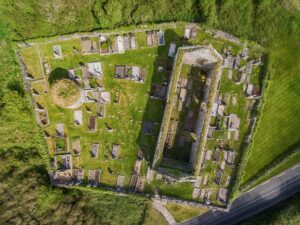
What gives it away, if anything does, is the gorse. Dense and thorny, it has colonised much of the interior, and beneath it, partly concealed, are hollows suggesting that someone, at some point, decided to dig into the old enclosure. What they were looking for, or what they may have found, is not recorded.
This is a rath, the most common form of early medieval settlement monument in Ireland, typically consisting of a roughly circular area enclosed by one or more earthen banks and used as a farmstead from around the sixth to the twelfth century. This particular example is subcircular in plan, measuring approximately 24 metres east to west and 22 metres north to south, with a bank around 5.5 metres wide. The bank itself is relatively low, rising only about 0.6 metres on the exterior and a mere 0.3 metres on the interior side, and erosion or disturbance has left no clear trace of any original stone facing. The site was already marked on the Ordnance Survey six-inch maps of both 1840 and 1916, shown with hachures, the cartographic shorthand used to indicate earthworks. By 1996 it had been catalogued, somewhat neutrally, as an enclosure. A stone field wall clips the northeastern edge, the kind of pragmatic agricultural intrusion that has altered countless such sites across the country over the centuries.