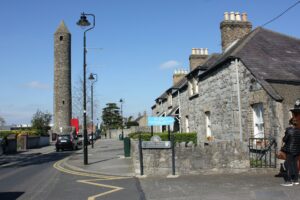
Bridewell Lane, running from a well to the Naas Road in the Clondalkin area, is not simply a local back route but a surviving fragment of a much older overland connection, one that once linked Clondalkin with Tallaght across what is now heavily suburban south County Dublin.
The identification of the lane as an ancient road comes from Ua Broin, writing in 1944, who traced its likely course and noted its origins as a pre-modern route between the two settlements. South of the Naas Road, the same alignment was recorded on maps as the 'Belgard Road', and in that stretch it passed to the west of, and very close to, both Newlands House and Belgard Castle. The detail matters because it places the road in relationship to two significant landmarks, suggesting it was not an incidental track but a purposeful route threading through an inhabited and managed landscape. Old roads of this kind often survived precisely because they were folded into later property boundaries, lane networks, and field edges, preserving the line of travel long after the original purpose had been forgotten.
The lane itself is not a dramatic or obviously ancient-looking feature; that is rather the point. Visitors to the Clondalkin area who want to trace the route would do well to consult historical Ordnance Survey maps alongside Ua Broin's 1944 account, which provides the clearest framework for understanding how the modern lane relates to the older alignment. The section south of the Naas Road, where the road ran near Belgard Castle, offers the most legible stretch of the historic route, and the proximity to those two named landmarks gives useful orientation. The area is accessible by road, though the interest here is less in any single monument than in the act of reading a contemporary streetscape and recognising, just beneath it, the faint geometry of an older journey.