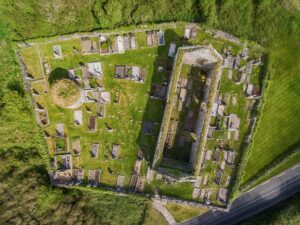
This is a souterrain, a type of dry-stone underground structure built throughout early medieval Ireland, most likely for storage or refuge, and occasionally connected to nearby settlement activity. What makes this one quietly interesting is its hybrid state: part roofed, part exposed, it reads almost like a cross-section of how such structures were built and how they fall apart over centuries.
The passage runs roughly north to south, measuring 2.6 metres in length and between 0.9 and 1.08 metres wide, with a present height of around 0.9 metres. The entrance is at the northern end. Moving southward, an unroofed stretch of about two metres gives way to a covered section where six roof lintels remain in place, with smaller stones heaped over them in what appears to be the original manner of construction. The southern end of the passage is blocked by rubble. The walls are built from small stones with no corbelling, meaning the sides rise vertically rather than curving inward to support a roof, and on the eastern side the wall base meets natural bedrock rather than laid foundations. The souterrain sits within a cashel, a roughly circular stone-walled enclosure of the kind associated with early Christian period farming settlements in the west of Ireland, and its position at the eastern centre of that enclosure suggests it was a deliberate and considered feature of the original layout rather than a later addition.