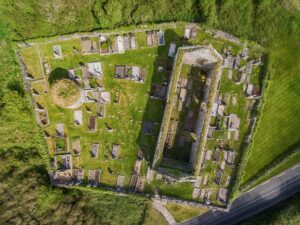
A souterrain is an artificially constructed underground passage or chamber, typically associated with early medieval settlements in Ireland, and often interpreted as a place of refuge, storage, or concealment. What makes this one quietly unusual is the way it straddles two states at once: one end broken and exposed, the other still intact, its rock-cut walls and roof essentially as they were when first made.
The structure sits at the centre of an enclosure, itself occupying the north-east corner of a hollow or quarry measuring roughly 25 metres east to west and 15 metres north to south. The passage runs ENE to WNW. The western end was breached at some point in the distant past, leaving a section of the north wall, 3.4 metres long and a metre high, still standing while the south wall has largely collapsed into a loose pile of stones about 3.5 metres across. From the evidence of that rubble, the south wall appears to have been constructed from fairly regular limestone blocks rather than simply cut from the bedrock. The eastern section, 3.8 metres in length, remains covered. Entry now comes through the broken western side, through an opening just over a metre wide and less than a metre high. Inside, the covered passage reaches a maximum height of 1.15 metres, its walls largely rock-cut, before a step up of half a metre leads to the natural rock-face that forms the eastern end-wall. The site appears on Robinson's 1977 map of the area, suggesting it has been a known landmark for decades at least, though its age, like that of most Irish souterrains, almost certainly stretches back considerably further than that.