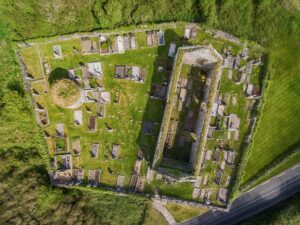
It might be a tank cut into the rock for holding water. It might be a souterrain, the kind of narrow underground passage, usually stone-lined, that early medieval communities used for storage or as a refuge. Or it might be something else entirely. That uncertainty has sat on the record for well over a century.
The antiquarian Thomas Johnson Westropp visited and documented the site, referring to it in publications from 1896 and 1913. He described what he found as "a well-defined rock cutting, a tank, or, more probably, a souterrain," and included it on a plan of the cashel he called Caher-Mhullach, where it appears annotated simply as "Rock cutting." On that plan, the feature is orientated roughly north-north-east to south-south-west, with an estimated length of around 4.5 metres. The cashel itself, a type of circular stone-walled enclosure associated with early medieval Ireland, provides the broader context, though even the relationship between the cutting and the cashel remains a matter of inference rather than excavation. Westropp was a prolific recorder of Clare's monuments, and his plans, though made with the tools of his era, remain a primary source for sites that have never been formally dug.