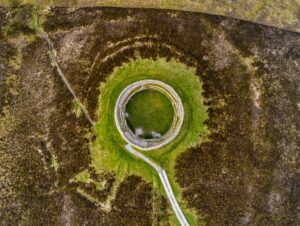
This particular example has been sealed off for decades, its entrance blocked and inaccessible to visitors. The site sits in what is now well cultivated farmland, a quiet reminder that beneath the everyday agricultural landscape of rural Donegal, ancient structures still slumber undisturbed.
Souterrains, from the French for 'underground', are stone lined passages that were built across Ireland between roughly 500 and 1200 AD. These subterranean chambers served various purposes; some archaeologists believe they were used for food storage, taking advantage of the cool, stable temperatures below ground, whilst others suggest they may have provided temporary refuge during raids. The Grange souterrain was first documented in 1949 by archaeologist Leo Swan, who noted its location but was unable to fully explore the structure due to the blocked access.
Though this particular souterrain cannot be visited, it forms part of a wider archaeological landscape around Burt Castle Hill that tells the story of continuous human settlement spanning thousands of years. The area's rich history is documented in the Archaeological Survey of County Donegal, compiled in 1983, which catalogues field antiquities from the Mesolithic period through to the 17th century. Whilst the Grange souterrain remains hidden from view, its presence serves as a tantalising hint at the secrets that still lie buried beneath Ireland's fields and farms, waiting to share their stories of the people who once sought shelter, stored their precious supplies, or perhaps hid from danger in these dark, stone passages.