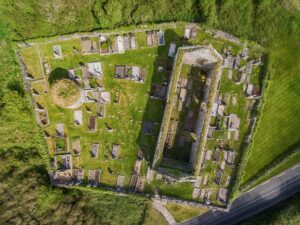
This is a souterrain, a type of dry-stone underground chamber or tunnel built during the early medieval period in Ireland, typically used for storage or as a refuge. What makes this one quietly arresting is the precision of its construction, still legible despite its age and partial collapse.
The souterrain sits in the south-eastern quadrant of a cashel, a circular stone-walled enclosure of the kind common across Munster from roughly the sixth to the twelfth centuries. The passage is oriented east to west and measures 4.8 metres in visible length, with an original height of around 1.1 metres, low enough to require crouching. Its walls were built using a corbelling technique, where the side-stones are angled progressively inward as they rise, giving the base of the passage a width of 1.4 metres while the top narrows to just 0.7 metres. Some of the individual stones incorporated into the walls are substantial, particularly along the northern side, where individual slabs reach up to 1.6 metres in length and 0.5 metres in height. Six roof lintels remain visible overhead, though one is missing, leaving a gap in the ceiling that would once have been sealed.