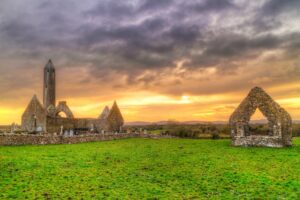
The west gable, with its blocked-up trabeate doorway, a flat lintel rather than an arch, a form associated with early Irish ecclesiastical construction, is considered the oldest surviving fabric, possibly eleventh or twelfth century. The nave beside it dates mainly to around 1200, while the transepts and a rebuilt chancel belong to the fifteenth century. The result is a church that was never completed in any single campaign but grew, was damaged, grew again, and finally fell silent sometime in the early thirteenth century after a series of attacks left it in ruins. The dimensions are modest by cathedral standards, the nave running twenty metres east to west and six metres wide, the chancel a further seven and a half metres, yet the variety of architectural detail preserved within that compact footprint is considerable.
The monastery here was founded in the sixth or seventh century by St Colman Mac Duach, on land granted to him by Guaire, King of Uí Fiachrach Aidne, a kingdom that covered much of what is now south County Galway. Kilmacduagh, whose name derives from the saint himself, grew into one of the significant ecclesiastical sites of Connacht. It was passed over as an episcopal seat at the Synod of Rathbreasail in 1111, a reforming church council that reorganised the Irish diocesan structure, but the community here pushed back, and by 1152 the bishopric of Kilmacduagh had asserted its right to independent status. The cathedral church that eventually rose on this site reflects that ambition, even if successive attacks brought it low before the medieval period was out.
What rewards a close look inside the roofless walls is the range of carved and shaped stonework still in place. A pointed arch doorway in the south wall of the nave carries a carved bishop's head above it. The north transept retains an ogee-headed window, its flowing curved profile characteristic of later medieval Gothic work, set above what appears to have been an altar. The chancel's east gable holds three-light tracery windows, as does the south wall of the south transept. Several doorways throughout the building are blocked, their outlines still visible, each one a record of some earlier arrangement that was later sealed off and overtaken by the next phase of construction.