Holy wells, traditionally venerated springs associated with early Christian or pre-Christian practice, are scattered across Ireland in their thousands, but this one occupies an unusually ambiguous position: it carries the name Tobermacduagh, which links it to a significant local saint, yet it sits some distance from the site most commonly associated with that name.
When recorded in January 1986, the spring was enclosed by a small D-shaped wall of drystone construction, meaning the stones were laid without mortar, a technique with roots stretching back to prehistoric building traditions in Ireland. The wall measured roughly two metres east to west and just under two metres north to south, with two rough steps cut into an eastern gap leading visitors down to the water itself. The name had appeared on Ordnance Survey maps as far back as 1838, and again on the 1921 edition, suggesting the site had long been considered notable enough to mark. More telling, perhaps, were the artificial flowers and fragments of pottery found at the well during that 1986 inspection, quiet signs that people were still coming, still leaving something behind. At that time, a small roadside shrine stood nearby to the east, a glass-fronted wooden case holding a crucifix, statues, holy pictures, and rosary beads. By 2019, the shrine had been relocated to the well itself, consolidating the devotional activity into one spot.
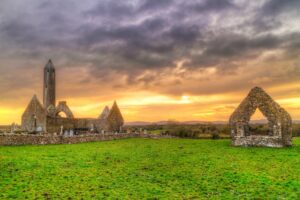
The other holy well bearing this name lies about 1.7 kilometres to the north-east, and is associated with the early medieval monastic complex of Kilmacduagh, one of the more prominent ecclesiastical sites in the region. That proximity, and the shared dedication, raises the possibility that this smaller well in Gortnacullia sits within an older, wider landscape of veneration connected to the same saint, its significance persisting quietly beside its better-known counterpart.