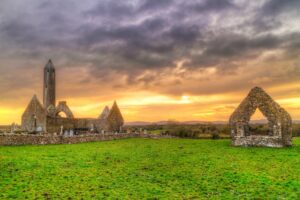
This one, set at the roadside about two hundred metres south-east of the great round tower at Kilmacduagh, has run dry. The spring is gone, the ground overgrown, and what remains is a modest semicircular enclosure of drystone walling, roughly three metres across at its widest, quietly collapsing back into the Galway landscape. Its ordinariness is, in a way, the point: this is not a showpiece but a working part of a monastic world that once organised itself around such spots.
The well is dedicated to St Colman Mac Duagh, the seventh-century founder of the Kilmacduagh monastery, and takes its name directly from him, "tobar" being the Irish word for well. Colman was a member of the Uí Fiachrach dynasty who, according to tradition, retreated to the solitude of the Burren before establishing his community here on the Galway plain. The well would have formed part of the devotional landscape surrounding the monastery, a cluster of sacred sites that included, until relatively recently, a holy tree that stood about fifty metres to the east. Such trees, often thornbushes or ash, were commonly associated with holy wells across Ireland, serving as places to leave votive offerings. Whether that tree still stands is unclear from what survives on the ground.
The site sits close to the road and is visible to anyone making their way around the wider Kilmacduagh complex, though the round tower and cathedral naturally draw most attention. The well's drystone enclosure is easy to miss, and its current state, overgrown and waterless, asks something of the visitor: a willingness to read absence as history.