That alone sets this ground apart. Chest tombs of this age are not especially common in County Dublin, and the fact that three have endured together in a single churchyard gives the site a quiet documentary weight that is easy to overlook.
One of the three carries an inscription that anchors it precisely in time and person: "Murce. Walsh died 6th April 1685." The name, possibly a contracted form of Maurice, belongs to a member of the Walsh family, and the date places the tomb in the later years of the seventeenth century, a period of considerable upheaval in Irish land ownership and religious life following the Cromwellian settlements and their aftermath. The tomb was recorded by Liam Price, whose edited volume of 1942 remains a key source for early Dublin monuments, and the site has since been catalogued under the reference DU021-037004- as part of the national archaeological inventory. Research on the site was compiled by Geraldine Stout.
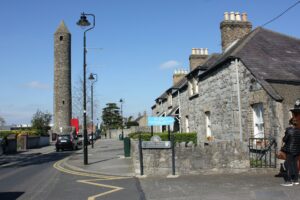
The churchyard sits in Tallaght, which is today absorbed into the sprawl of south-west Dublin but retains traces of a much older settlement history around its old church site. The three seventeenth-century tombs are chest tombs, a form in which a rectangular stone box sits above ground level, sometimes with a carved slab on top, and which were typically reserved for families of some local standing. Visitors should look carefully at the inscriptions, which can be worn and require close attention to read. The site is accessible as part of the existing churchyard, and the tombs are best examined in good daylight when low-angle light can help bring shallow carving into relief.