
Religious house - Franciscan friars, Roosky, Co. Monaghan
Co. Monaghan |
Religious Houses
In the modern streetscape of Monaghan town, between the Diamond and Convent Lake, a Franciscan friary once stood, was sacked, cannibalised for building stone, and then quietly forgotten, to the point where archaeologists digging across an extensive area of the likely ground in the 1990s found nothing at all.
The friary exists now only in a handful of historical references, a pair of old maps, and the bones that turned up when the open space before the old gaol was levelled, presumably centuries after anyone had thought to mark the burials.
The house was founded in 1462 by Phelim McMahon, and it accumulated the kind of history that comes with being an institution of any importance in late medieval Ulster. Phelim McGuire was buried there in 1519. In 1539, a man named Ruaraí Mac Redmond Mac Mahon was dragged from sanctuary within its walls and murdered, an act that would have been understood at the time as a serious violation of the protection a religious house was supposed to afford. The friary became Observant, meaning it adopted the stricter rule of the Franciscan reform movement, in 1567. Then, in what the Annals of the Four Masters record under 1540 but which is more plausibly dated to 1589, English forces sacked the friary; the guardian and five others were killed. The Lord Deputy Sir William FitzWilliam is named in connection with this, though the chronological confusion means Lord Leonard Grey cannot be entirely ruled out. A garrison was left behind, probably withdrawn after the battle of Clontibret in 1595. The friary's lands passed first to Edward White, then to Edward Blayney in 1606, confirmed in 1612. Blayney is said to have demolished what remained to build a castle nearby, of which no trace survives either.
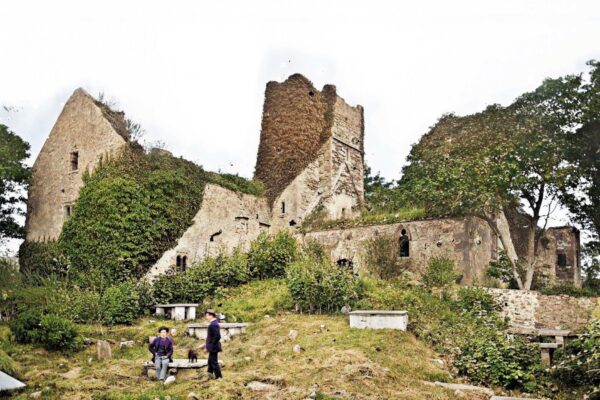
What the friary actually looked like is a matter of some guesswork. A map of around 1590 shows a simple rectangular building with a battlemented tower, set at what may have been the junction of nave and chancel. No cloister or ancillary buildings are shown, and they probably never existed. A later depiction by the cartographer Bartlett, made around 1602, renders it as a more elaborate structure at some remove from the town, but this is generally considered unreliable on the relative positions of features. By 1835, the Ordnance Survey was recording only some old walls behind a large house on the Diamond, said locally to be the remains of an abbey. Excavations in the 1990s tested the ground across the area where the friary most plausibly stood and returned no structural evidence whatsoever. The building has been entirely consumed, first by time and then by its own successor.
Ref: MO00185
04-Essential
Nearby Places
Visitor Notes
Added by

Pete F
Ó Mearáin, L. 1956 The Battle of Clontibret. Clogher Record, vol. 1, No. 4, 1-28.
Swan, R. 1997a Dawson Street / Dublin Road, Monaghan. Urban. in I. Bennett (ed.) Excavations 1997: summary accounts of archaeological excavations in Ireland, 90, No. 317. Bray, Wordwell
Swan, D. L. 1997b Town centre carpark development, Dublin Road, Monaghan. Urban. in I. Bennett (ed.) Excavations 1997: summary accounts of archaeological excavations in Ireland, 90-1, No. 318. Bray, Wordwell
Coyle, M. 1980 (ed.) Letters Patent to Sir Edward Balyney dated 18th June 1612. Clogher Record, vol. 10, No. 2, 215-222.
McKenna, Rev. J. E. 1920 Parochial History of the Diocese of Clogher. 2 vols, Enniskillen, Author
Herity, M. (ed.) 2012 Ordnance Survey Letters: Londonderry, Fermanagh, Armagh-Monaghan, Louth, Cavan-Leitrim. Dublin, Fourmasters Press
AU (1983) – The Annals of Ulster to 1311, ed. S. Mac Airt and G. Mac Niocaill (Dublin 1983)
AFM – Annals of the kingdom of Ireland by the Four Masters from the earliest period to the year 1616, ed. and trans. John O’Donovan (7 vols., Dublin, 1851; reprint New York, 1966)
Gwynn, A. and Hadcock, R.N. 1970 (Reprint 1988) Medieval religious houses of Ireland. Dublin. Irish Academic Press.
Lewis, S. 1837 A topographical dictionary of Ireland, 2 vols. London. Lewis and Co.
Mooney, C. 1955 Franciscan architecture in Pre-Reformation Ireland, Part I. Journal of the Royal Society of Antiquaries of Ireland 85, 133-73.