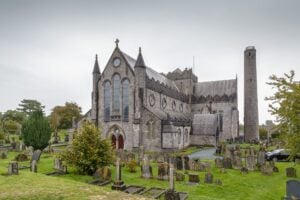
The public road along the north-western side of the graveyard follows a gentle curve, and that curve, together with the triangular outline of the burial ground itself, suggests the two features together represent the north-western wedge of what was once a roughly circular enclosure approximately 120 metres in diameter. Ecclesiastical enclosures of this kind, broad ringwork boundaries that defined the sacred and domestic space of an early medieval church site, were once common across Ireland, though most have been reduced over centuries to little more than faint traces in the landscape.
The name of the place tells its own story. When Ordnance Survey officers recorded this parish in 1839, they noted that the church was known as Teampall Ratha Uachtair, meaning the Church of Ratha Uachtair, and that it was said to have stood within a rath, an earthen ringfort. By that point even the foundations were impossible to trace, the ground having been so thoroughly disturbed by generations of grave-digging. The historian Carrigan, writing in 1905, repeated the same tradition, that the church had stood within the rath from which the parish itself takes its name. Outrath, in other words, carries its own archaeology in its placename. The physical evidence caught up with the tradition in 1996, when excavations carried out ahead of reservoir construction just south of the graveyard boundary uncovered a spread of settlement debris containing charcoal, animal bones, and fragments of medieval pottery. This material, though modest in area, demonstrated that the medieval occupation of the site extended well beyond the current limits of the graveyard, lending weight to the idea of a substantial enclosed complex that once surrounded the church.