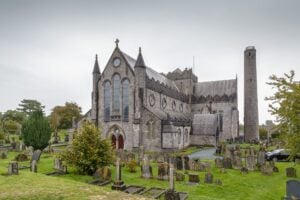
Religious house - Augustinian canons, Gardens, Co. Kilkenny
Co. Kilkenny |
Religious Houses
On the east bank of the River Nore in Kilkenny, a roughly two-acre walled precinct once contained not just a priory church and cloister, but an entire self-sufficient world: bake-house, brew-house, barn, a lime-kiln (used for making mortar and processing agricultural land), gardens for the kitchen and infirmary, orchards, a pigeon house, and a water-mill.
The dissolution inventory of March 1540 recorded all of it in the dry language of seizure, listing thirty-three gardens and a hundred acres of arable land among the priory's broader holdings, which extended to over 240 acres in total, including a wood referred to as 'Chanons grove'. What is left of that precinct today sits quietly in the fabric of the city, bounded by Back Lane, Michael Street, John Street, and a mill-stream known as the Little River, the whole absorbed so thoroughly into later urban development that the scale of what once stood here is easy to miss.
The priory of the Augustinian canons of St John the Evangelist was founded by William Marshal, Earl of Pembroke, to replace an earlier hospital dedicated to St John the Evangelist, thought to have stood near Green's Bridge to the north. The new lands appear to have been allocated by 1211, and around 1223 William Marshal the younger confirmed the original grant by charter, dedicating the site 'in honour of God and St John the Evangelist and to sustain the poor and indigent.' The church grew through the 13th century with nave, chancel, and tower; a Lady Chapel was added in 1290; and a substantial rebuilding took place in 1325, followed by the collapse of the bell tower in 1329 to 1330. A drawing of Kilkenny made around 1698 by the artist Place still showed the priory with a long nave, lancet windows, and a substantial tower. By 1615, the nave and chancel were already ruinous. After the dissolution, the precinct passed to Kilkenny Corporation and was carved up among merchant families including the Rothe, Archdekin, Shee, and Langton; a 1628 rental roll records chambers in the cloister, a cart gate, a castle, a bake-house, and a chapter house still in use or at least still standing. In 1645 a Jesuit chapel and college were briefly established here, but in the late 17th century much of the nave and the domestic buildings were demolished, their stone reused to build a military barracks, which was later converted into an asylum in 1818.
What survives above ground today includes most of the chancel, a fragment of the nave, parts of the west range of the cloister, and the Lady Chapel, which was incorporated into the present St John's Church of Ireland building in 1817. The chancel's east gable is particularly worth attention: it carries two sets of graded three-light cusped trefoil-pointed windows, each with hood-mouldings and decorative head-stops, a quatrefoil window above, and a narrow flat-headed single light at the apex. Inside, the window arrangements sit within moulded rear-arches on banded shafts. A portion of the rib-vaulted ground floor of the west range also survives, with two blocked pointed doorways still visible within a pointed arched recess, one of which once opened east into the cloister.
Visitor Notes
Added by