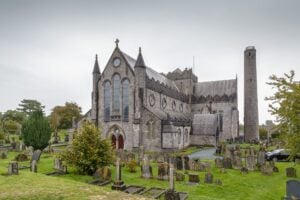
Saint Francis Abbey (in ruins), Gardens, Co. Kilkenny
Co. Kilkenny |
Religious Houses
What stands beside the Smithwick's brewery site in Kilkenny is not quite a ruin in the ordinary sense.
The chancel walls of this thirteenth-century Franciscan friary rise to around eight and a half metres, the east gable to roughly twelve, and the whole structure sits on an unusually tall plinth, in places nearly four metres high, designed to compensate for the soft alluvial ground at the confluence of the River Nore and the River Breagagh. Low, wide relieving arches, set into the base of the east end of the chancel, distribute the load further still. The building has been a brewery outbuilding, a racquet court, a barracks, and a dumping ground for coopers' sheds, and yet the choir walls still stand, the bell tower survives, and the fabric holds a surprising amount of readable history.
The friary was founded by Richard Marshall, 3rd Earl of Marshal, shortly before his death in 1234, though King Henry III found it necessary in 1246 to grant money to the Friars Minor of Kilkenny to construct their buildings and clear their debts, which suggests the project had stalled early. The chronicler Friar Clyn, a member of the community, recorded the raising of a new choir in 1321 and the consecration of the high altar in 1323 to 1324, an altar later described around 1615 as a single slab of polished Kilkenny limestone measuring seven and a half metres by just over one metre. In 1338 a major flood left almost nothing untouched except that altar and its steps. Clyn went on to record the arrival of the Black Death in 1348, writing until June 1349, when he is presumed to have died of the plague himself. Excavations between 1970 and 1980 uncovered irregularly buried individuals in the western ambulatory of the cloister, likely victims interred in haste. At the Dissolution of the Monasteries in 1540, the friary's assets included a weir on the Nore, a water mill, a granary above three cellars, and an orchard; it was granted to the sovereign Walter Archer and the commonalty of Kilkenny in 1543. The friars were expelled in 1550, returned briefly under Queen Mary in 1553, expelled again under Elizabeth in 1559, and the church remained in intermittent use until 1650. By 1698 the site had been assigned for barracks, the cloister demolished to make way for a horse barrack, and by 1710 the precinct had been absorbed into the brewery founded by the Smithwick family.
By 1872 the choir windows, walled up for perhaps a century and used as a racquet court, had been reopened, and the sedilia, the recessed seats set into the south wall of a chancel for officiating clergy, had been repaired. A coopers' shed had been built directly against the central mullions of the great east window while it was still blocked. The brewery retained ownership of most of the site until 2012, when Kilkenny County Council purchased it. The chancel and tower are now accessible within the former brewery gardens, and the fabric itself, particularly the visible seam in the north wall where the east end was rebuilt in the early fourteenth century, possibly after subsidence, rewards anyone who looks closely at the stonework rather than simply past it.
Visitor Notes
Added by