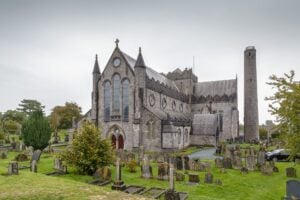
This discovery, made during pavement removal at the base of the round tower adjoining St Canice's Cathedral in Kilkenny city, has quietly accumulated layers of scientific and historical attention across two centuries, and the graveyard surrounding the cathedral has proved just as revealing.
The antiquarian James Graves first documented the tower burials, working alongside a medical doctor, Dr. Crane, whose analysis of the retained skulls appeared in print in 1857. One child's skull was examined and then lost somewhere along the way, no longer traceable in the National Museum's collection. The two adult skulls that survived, however, were exhibited at the Kilkenny Museum in June 1892, according to a notice in the Kilkenny Moderator, and they are now held in the National Museum of Ireland's Collections and Resource Centre. Radiocarbon dating has since placed these individuals firmly in the early Christian period, one dying between AD 880 and 990, the other between AD 990 and 1150, broadly confirming what Dr. Crane concluded from physical examination alone. The three adult burials had been interred at different depths; one lay too deep to excavate safely and was left undisturbed. Beyond the tower, excavation of a Victorian pipe-trench south-east of the cathedral chancel revealed nine further interments across two phases, recorded but left in place. An emergency excavation in the south-western part of the graveyard uncovered seven adult burials representing five phases of use spanning the 13th to 19th centuries. Among these, a probable medieval skull bore the bone damage characteristic of tertiary syphilis, and a female tibia showed evidence of a sharp-force injury, the kind of detail that turns a graveyard record into something closer to biography.