
Church, Garristown, Co. Dublin
Co. Dublin |
Churches & Chapels
Scattered around the walled graveyard in the north County Dublin village of Garristown are at least five stones that most visitors would take for ordinary grave-markers.
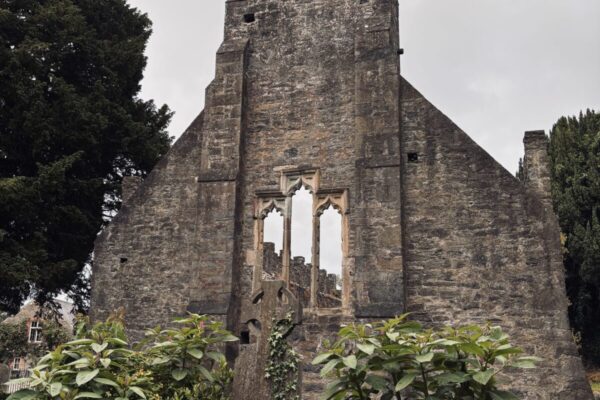
They are not. These are medieval rainwater drainage chutes, probably salvaged from a much older church that once occupied this same elevated ground, and quietly reused by whoever was building or repairing the graveyard in the nineteenth century. A small punch-dressed stone of sixteenth-century date, now set into a tomb surround in the south-east corner, was almost certainly lifted from the same vanished building. The 1888 Church of Ireland structure that stands here today is, in that sense, only the most recent layer of a site that has been continuously religious ground for the better part of a millennium.
The medieval church of Garristown, known in Latin records as Villa Ogari or Balyogary, sat within the Gaelic territory of the O'Cathasaigh, the O'Caseys, whose lands were roughly co-extensive with the barony of Balrothery West. Around 1200, Archbishop Comyn granted the church, which was dedicated to the Blessed Virgin Mary, to the priory of Llanthony in Gloucestershire. The arrangement did not last: Llanthony surrendered it shortly after 1212, and it passed to the Hospitallers of Kilmainham, the Irish house of the Knights Hospitaller, who thereafter appointed the vicar. By the ecclesiastical taxation of 1302 to 1307, the church was valued at £20 per annum within the Deanery of Swords. The manor moved through the hands of the D'Arcy and Talbot families in the fourteenth and fifteenth centuries. In 1410, the then-vicar, Thomas Corre, was given leave to absent himself for five years to study at Oxford. By 1630, the picture was considerably less dignified: Archbishop Bulkeley's visitation noted that the church was ruinous and that parishioners were resorting instead to a large empty straw-roofed house in the village to hear Mass, attended by a vicar named John Mooney who, according to the 1615 visitation, served a reading minister with no books.
The graveyard is accessible in the village of Garristown, which sits in the rolling farmland of north Fingal. The 1888 church itself is a modest structure, not the focal point of a visit so much as a backdrop to the graveyard that surrounds it. What repays close attention is the stonework underfoot and along the boundaries: the repurposed chutes are easy to overlook if you are not specifically looking for them, but once spotted they prompt a different way of reading the whole site. A 3D model of one of the rainwater chutes from the graveyard has been made available online at skfb.ly/oDUWN, which is worth consulting before or after a visit to understand exactly what you are looking at.
Ref: DU00043
04-Essential
Nearby Places

Visitor Notes
Added by

Pete F
Fingal Historic Graveyards Project 2008, Vols. 1 and 2 http://www.fingal.ie/planning-and-buildings/heritage-in-fingal/heritage-and-communities/historic-graveyards/
Walsh, Rev. R. 1888a Fingal and its churches. Dublin. William McGee.
White, N.B. 1943 Extents of Irish monastic possessions, 1540-1541. Dublin. Irish Manuscripts Commission.
Lewis, S. 1837 A topographical dictionary of Ireland, 2 vols. London. Lewis and Co.
Simington, R.C. (ed.) 1945 The Civil survey, AD 1654-1656. Vol. VII: county of Dublin. Dublin. Irish Manuscripts Commission.
Ronan, M.V. 1941 Royal Visitation of Dublin, 1615. In Archivium Hibernicum 8, 1-55.
Ronan, M.V. 1941 Archbishop Bulkeley’s Visitation of Dublin, 1630. Archivium Hibernicum 8, 56-98.
D’Alton, J. 1838 (Reprint 1976) The history of the county of Dublin. Cork. Tower Books.
Cal. doc. Ire. – Calendar of documents relating to Ireland 1171-1307, ed. H.S. Sweetman (5 vols., London, 1875-86).