
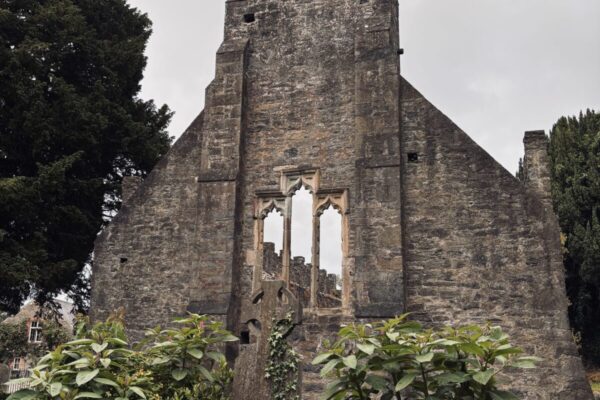
Church, Kilmartin, Co. Dublin
Co. Dublin |
Churches & Chapels
There is nothing left to see at Kilmartin, and that is precisely what makes it worth knowing about.
Somewhere in this stretch of lowland tillage in County Dublin, a medieval church once stood within a curvilinear ecclesiastical enclosure, ringed by two widely spaced fosses, the term for ditches cut to define and defend a boundary. The road still bends around where the outer enclosure would have been, a gentle curve in the tarmac that hints at something the landscape has otherwise forgotten. No wall, no mound, no earthwork breaks the surface. The site exists now almost entirely in the archive.
The Ordnance Survey map of 1837 recorded a church within an enclosure at this location, catalogued in the Sites and Monuments Record as DU013-002002. Aerial photographs, including one referenced as OS 8/7584, revealed the enclosure as a cropmark, the kind of shadow that buried archaeology casts upward through soil and into growing crops during dry summers, made legible only from above. A later aerial photograph, GB89.AE.10, showed the church position more clearly, still surrounded by the outline of that double-fossed curvilinear boundary. Whatever physical remains had survived into the twentieth century were levelled sometime between 1971 and 1976, a period when agricultural intensification across lowland Ireland saw many such earthworks removed. Large-scale field fence removal has since further altered the surrounding landscape. The site record was compiled by Geraldine Stout and updated by Christine Baker.
A visitor to Kilmartin today would find no obvious focal point, and that is worth understanding before making the effort. The value here is less in what can be observed on foot and more in what the road itself quietly preserves. The slight curve that bends to respect the line of the outer enclosure, roughly 150 metres east to west and 110 metres north to south, is the only legible trace at ground level. If you have access to the aerial photographs held in the national record, comparing them against the modern field pattern gives a clearer sense of how much has been lost and how recently. This is a site for those interested in landscape reading rather than monument visiting, the kind of place where absence is itself the thing to notice.
Ref: DU00533
Nearby Places

Visitor Notes
Added by
