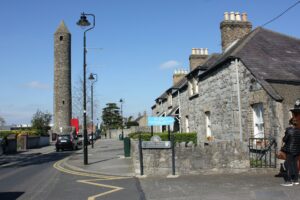
It is, in all likelihood, tracing the ghost of an early medieval monastic enclosure, the kind of roughly circular or oval boundary that once defined the sacred and functional territory of an Irish monastery. The arc of that curve appears to continue across the road to the west, where it is thought to have swept around into what are now the priory lands, suggesting that the original enclosure was considerably larger than anything visible today.
The monastery in question was that of St Maelruan, a significant early Christian foundation at Tallaght. The true extent of its enclosure has been difficult to pin down precisely, but archaeological investigations have offered some physical evidence. In 1991, ahead of construction of a new regional technical college, test trenches were opened in the area but failed to find the expected continuation of the boundary. What they did find were two ditches, possibly belonging to an inner enclosure of the kind that sometimes subdivided larger monastic sites into distinct zones. These ditches had been deliberately in-filled sometime during the thirteenth or fourteenth century, and measured between five and eight metres wide and around 1.4 metres deep. Concentric ditches of a similar character were also identified to the south-west of the present church boundary. A further trench excavated in 1995, to the west of St Maelruan's, revealed a single ditch measuring 4.7 metres wide and 1.2 metres deep, with a sherd of medieval pottery recovered from its lowest layer, placing human activity there firmly within the medieval period.
Tallaght is now thoroughly absorbed into the suburban spread of south-west Dublin, which makes the survival of these traces all the more worth pausing over. The churchyard itself is findable without difficulty near the older centre of the town, close to the Dominican priory. The curvature of the graveyard wall on the south-western side is the detail to look for, a slight but deliberate bend in the boundary that most people walk past without a second thought. There is nothing to excavate or handle, of course, but knowing that beneath the surrounding ground lie silted-up ditches once associated with one of early medieval Ireland's more important monastic settlements changes how the whole streetscape sits.