
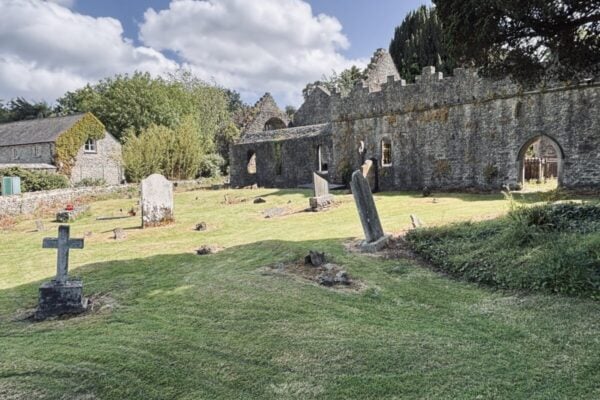
Burial ground, Butterfield, Co. Dublin
Co. Dublin |
Burial Grounds
When workmen began development at the site of the Old Orchard public house on Butterfield Avenue, Rathfarnham, in 1997, they did not expect to find an early medieval cemetery beneath the foundations.
Yet that is precisely what emerged, and it was not even the first time. Human skeletons had already been recovered in the area in 1950, recorded by the National Museum of Ireland, suggesting that burials had been surfacing here, and being noted and then largely forgotten, for decades before anyone thought to look more carefully.
Trial excavations in 1997 revealed that the site had a long and layered history. The earliest phase of occupation, dating to the early medieval period, was marked by a palisade trench, a defensive or boundary feature formed by upright timber posts set into the ground. Associated finds included copper, iron slag, animal bone, iron knives, a penannular brooch terminal, and what is described as a pig fibula pin. A penannular brooch is a type of ring-shaped fastening, common in early medieval Ireland, with a gap in the ring through which a pin passes. The finds point to a settled, working community. Burial activity followed, and the graves appear to have respected the curvilinear enclosure boundary that is still faintly visible on the first edition Ordnance Survey six-inch map, where the curve of the old road and the surrounding field lines trace what archaeologists interpret as a former ecclesiastical enclosure. Churches in early medieval Ireland were frequently surrounded by a roughly circular or oval ditched boundary, and the overall pattern here fits that model well. Many of the burials contained a distinctive detail: narrow stones placed on either side of the skull, described in the excavation notes as being set in ear-muff fashion, a method of holding the head in position that has been observed at other early Christian burial sites. The site appears to have seen renewed occupation again in perhaps the twelfth or thirteenth century.
Butterfield Avenue is a suburban road in Rathfarnham, south Dublin, and the site itself now lies beneath later development. There is nothing visible above ground to mark what was found here. Its interest is less in what can be seen than in what the street plan still faintly records, since the curve of the road that helped identify the enclosure boundary is there for anyone who looks at a map with some curiosity about why old roads bend the way they do.
Ref: DU03898
04-Essential
Nearby Places
Visitor Notes
Added by

Pete F
Cahill, M. and Sikora, M. (eds) 2011 Breaking ground, finding graves – reports on the excavations of burials by the National Museum of Ireland, 1927-2006, 2 vols. Dublin. Wordwell Ltd. in association with the National Museum of Ireland.
Carroll, J. 1998a The Old Orchard Inn, Butterfield Avenue, Rathfarnham. In I. Bennett (ed.), Excavations 1997: summary accounts of archaeological excavations in Ireland, 59-60. Bray. Wordwell.
Carroll, J. 1998b Vicar Street/58-9 Thomas Street, Dublin. In I. Bennett (ed.), Excavations 1997: summary accounts of archaeological excavations in Ireland, 55. Bray. Wordwell.