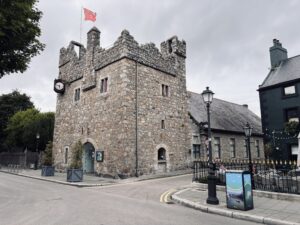
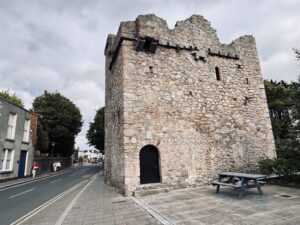
That, in a sense, is the point. The ground here was once part of a system of fortified town defences, a curtain wall and at least one tower that would have defined the limits of the medieval settlement at Bullock, on the southern edge of what is now Dalkey. No surface trace survives. The archaeology is entirely invisible, absorbed into the ground beneath the terrace, and the place would pass without a second glance from anyone who did not already know to look.
What survives instead is a paper record, and it is a surprisingly good one. Gabriel Beranger, an artist of Dutch origin who travelled Ireland in the eighteenth century documenting antiquities, made a drawing in 1766 of what he called the Bullock Watch Tower. His sketch shows a two-storey structure with a crenellated battlement, that is, the familiar notched parapet associated with defensive walls, marked by a horizontal string course, a projecting band of masonry running across the face of the wall. A section of curtain wall, the straight defensive walling that would have connected towers in a fortified enclosure, runs to the south-east of the tower in the drawing. By the time the first edition Ordnance Survey six-inch map was published in 1843, a turret was still visible to the south-west of Bullock Castle. That structure was removed before the century ended. When it came down, its base revealed massive wall foundations, which were interpreted by O'Flanagan in 1941 as the physical remains of the town's defensive circuit.
There is no access point to speak of, no signage, and no earthwork to orient yourself against. Castle Terrace itself is a residential address on Ulverton Road, and the harbour below remains in use. For anyone with an interest in the layers beneath ordinary-looking places, the value here is less in what can be seen and more in the act of holding Beranger's 1766 sketch up against the present streetscape, tracing in the mind what once stood two storeys high with battlements, and understanding that the removal of a single turret in the late nineteenth century was enough to erase the last legible fragment of a defended medieval settlement from the surface of the ground entirely.