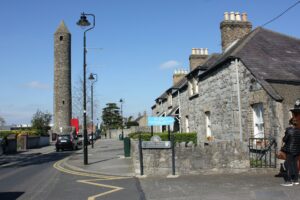
The church was built in 1790, oriented unusually on a north-south axis rather than the more conventional east-west alignment, but the ground it sits within had already been accumulating centuries of use long before that. Scattered across the roughly D-shaped enclosure, which measures approximately 50 metres north to south and 57 metres east to west, are two early-medieval granite crosses, an early-Christian baptismal font in the southern quadrant, and at least three architectural fragments salvaged from a medieval church that once stood on or near this site and has since been levelled. A surviving fragment of that earlier structure still stands to the south-east of the Georgian church, quietly marking what came before.
The boundary wall that curves along the eastern side of the graveyard drew attention even before the current church was built. The antiquary Austin Cooper noted it in his diary in 1780, a decade before St John's was constructed, describing it as already appearing very old. His observation was later cited by Price in 1942. The wall's polygonal, roughly D-shaped form is itself a feature worth noticing; such curving enclosures are often associated with early ecclesiastical sites in Ireland, where circular or D-shaped boundaries frequently predate the Norman period. The medieval church that originally occupied the site is recorded in the archaeological register, and the presence of the baptismal font, a stone basin used for Christian initiation rites, alongside the two granite crosses, suggests this was a place of some religious significance in the early-Christian period, well before the eighteenth century gave it its current Georgian face.
The graveyard is entered through a gateway at the north-west, with a second entrance on the south side leading to a later extension. Memorials within the enclosure date from the seventeenth to the nineteenth century, so there is a reasonable spread of funerary stonework to look at alongside the earlier material. The architectural fragments from the demolished medieval church are visible within the graveyard rather than housed anywhere, so they can be examined directly. The early crosses and font are on the eastern and southern sides respectively, and given the modest size of the enclosure they are not difficult to locate once you know to look for them.