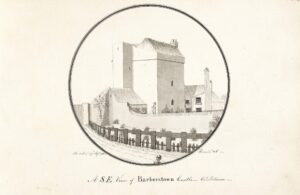
Above the back door of a long-disused farmhouse in Reeves, County Kildare, a small stone plaque sits largely unnoticed, its carvings slowly disappearing under a thick coating of green mould. Roughly forty centimetres wide and fifty centimetres tall, it carries a horizontally elongated lozenge, a diamond-like heraldic shape, with a small raised boss at its centre. Flanking it above are two further bosses, and above those, two slightly smaller ones, each of which appears to bear an animal figure, possibly a hound, though the biological creep across the stone has made any firm identification difficult.
The farmhouse itself dates from the late eighteenth or nineteenth century and abuts Reeves Castle, the two structures sitting in close proximity in a way that suggests the farm was built to serve or complement the older fortified complex. Armorial plaques of this kind were typically installed to advertise the identity or aspirations of a household, displaying heraldic devices associated with a family name or lineage. The lozenge form has particular heraldic significance, having been used in certain traditions to denote the arms of a woman, though it also appears in more general decorative and heraldic contexts. Whatever its original intent here, the plaque was considered important enough to be positioned at an entrance, even if only the back one, and its imagery of paired bosses and possible animal supporters hints at something more considered than simple ornament. The identity of the family whose arms these might represent remains obscured, much like the carvings themselves.