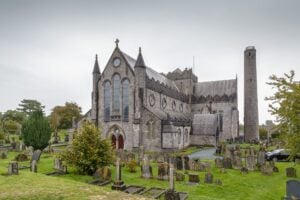
The area, known as the Deanery Orchard, sits roughly forty metres south-east of the cathedral, and its peculiarity lies in precisely that distance. One adult burial was found fifteen metres south of the graveyard's present boundary wall, meaning whoever was laid there rested just outside the consecrated ground rather than within it. Two further burials, one of an infant, lay towards the centre of the site. All three were orientated east to west with the heads to the west, following the conventional Christian practice of burying the dead to face the rising sun at resurrection. None of the graves appears to represent an extension of the main graveyard; they are more likely extra-mural interments, a term for burials placed deliberately beyond the formal cemetery boundary, a practice that sometimes reflected social exclusion, the status of unbaptised infants, or simply circumstance. All three were preserved in place rather than removed.
The Deanery Orchard has a layered history that makes the presence of these burials all the stranger. John Rocque's 1758 map of Kilkenny shows the site looking almost exactly as it does today, though the nineteenth century later divided it into three enclosures with stone fences. Before it served as the orchard for the Deanery, which sat on the opposite side of Coach Road, a road built in 1690, the land formed part of the plot belonging to the precentor's manse house within the Cathedral Close. The precentor was a senior cathedral official responsible for music and liturgy, and his residence would have made this a firmly ecclesiastical precinct. Test-excavations carried out separately by Andrew Gittens in 2002 and Cóilín Ó Drisceoil in 2006 uncovered the burials, along with glazed red earthenware pottery of eighteenth or nineteenth century date found within one of the grave-cuts, and evidence that the graves had been dug into post-medieval cultivation soil, suggesting the ground had been worked for growing before, or alongside, its use for burial.