
Church, Baldongan, Co. Dublin
Co. Dublin |
Churches & Chapels
Most people passing through north County Dublin would not think to look for a medieval church on a hill summit near Skerries, and fewer still would guess that the locals call it a castle.
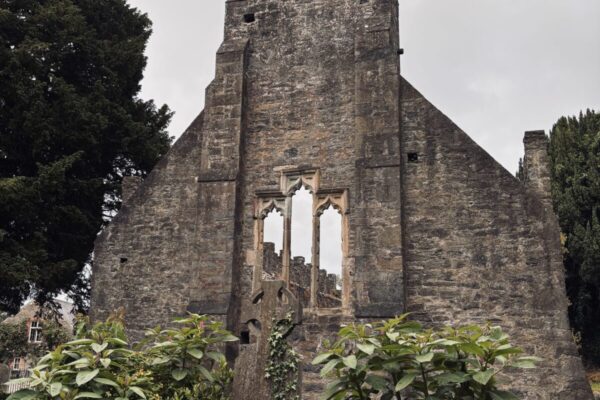
The confusion is understandable. What survives at Baldongan is not quite one thing or another: a ruined rectangular parish church, yes, but attached to a three-storey residential west tower of the kind that blurs the line between ecclesiastical and defensive architecture. The tower has a barrel-vaulted ground floor, a chimney breast carried on corbels, and a double bellcote sitting above the east wall. Someone, at some point, was living here as well as praying.
The church's history reaches back to around 1190, when it was granted to Kilbixy, though an agreement with the bishop meant that money from the parish was also directed to the cathedral. That dual obligation hints at the administrative complexity of medieval church governance in the area. By 1630, a contemporary source recorded it as being in a ruinous condition, having needed a roof for many years, and the Civil Survey of 1654 to 1656 described it simply as "ye walls of ye parish church", which suggests the building had long since ceased functioning. The fabric that survives is detailed despite its decay: the nave, measuring roughly 12.70 metres east to west, is separated from the narrower chancel by broken masonry known as tie-stones, and the chancel contains double-arched recesses on both the north and south walls. Set into the south recess is a carved shield portraying the crucifixion, an altar, candles, and angels. There is also an aumbrey in the east wall, a small recess used for storing communion vessels, a detail that speaks to the care once taken over the liturgical interior.
The church sits within a walled graveyard on a prominent hill, and the site is a National Monument in state care. The tower is the most visually arresting element from a distance, and up close the pointed arched doorways in the nave reward attention. The stairwell in the west projection of the tower is lit by narrow slit openings, and tradition holds that from the top it is possible to see across thirteen counties. The graveyard remains in use, so the site is generally accessible, though the interior of the tower itself may not be. Clear days in late autumn or winter, when the surrounding landscape is unobscured by foliage, give the best sense of why this particular hill was considered worth building on in the first place.
Ref: DU00155
04-Essential
Nearby Places

Visitor Notes
Added by

Pete F
Simington, R.C. (ed.) 1945 The Civil survey, AD 1654-1656. Vol. VII: county of Dublin. Dublin. Irish Manuscripts Commission.
Ronan, M.V. 1941 Archbishop Bulkeley’s Visitation of Dublin, 1630. Archivium Hibernicum 8, 56-98.