
Dromore Castle, Dromore, Co. Clare
Co. Clare |
Tower Houses
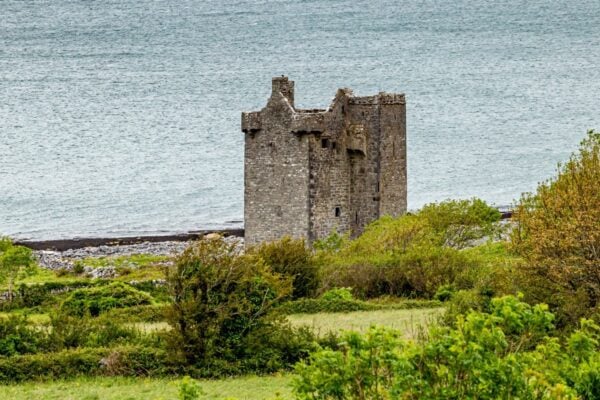
Set on what was once a small island at the northeast end of Dromore Lake in County Clare, the ruins of Dromore Castle stand amongst natural deciduous woodland, connected to the north and south shores by causeways.
The castle was likely built in the 16th century by Teige O'Brien, second son of Connor, third Earl of Thomond, and his wife Slany Brien; a stone plaque above the front door bears a partial inscription recording their names, though the exact date has been lost to time. The castle came into the O'Brien family's possession following an inquisition at Ennis in 1589, and Teige and Slany made it their home for most of their lives, raising three sons and a daughter within its walls.
The O'Briens' tenure at Dromore was marked by the turbulent politics of the era. In 1599, when O'Donnell marched south to invade Connaught and Clare, it was Teige who served as his guide and advisor against his own brother Donough, who had sided with the English. Teige's three sons later appeared as insurgents during the 1642 siege of Ballyalla Castle, continuing the family's involvement in Ireland's conflicts. The last O'Brien to occupy the castle was Conor, who departed in 1689, after which the structure fell into ruin during the 18th century.
Today, only the east wall with its stairwell and chambers survives, along with portions of the adjacent north and south walls of what was once a three storey tower house measuring approximately 12.7 metres east to west and 9.54 metres north to south. Built from roughly coursed limestone with rounded corners at the northeast and southeast angles, the castle retains fascinating architectural details including a pointed entrance doorway with guide holes for a yett (iron gate), decorated jambs with hatched patterns, and a small guard room complete with a squint overlooking the main entrance. The surviving structure reveals multiple levels with barrel vaulted ceilings, various chambers including mezzanines, garderobes, fireplaces, and a wall walk with crenellations; evidence suggests some modifications were made in the early 17th century, particularly to windows and fireplaces. Now designated as a national monument under state care, Dromore Castle offers visitors a glimpse into both the defensive architecture and domestic arrangements of a 16th century Irish tower house.
Ref: CL02929
04-Essential
Nearby Places
Visitor Notes
Added by

Pete F
Salter, M. 2004 The castles of North Munster. Worcestershire. Folly Publications.
Ua Cróinín, R. and Breen, M. 1997 The castles and tower-houses of Co. Clare, 6 vols. Unpublished report submitted to the National Monuments Service, Department of Culture, Heritage and the Gaeltacht, Dublin.
Ua Cróinín, R. and Breen, M. 1984 Dromore Castle – Ruan. The Other Clare 8, 14-15.