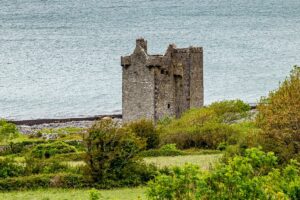
This battered profile, wider at the base than at the parapet, was meant to deflect cannon fire rather than absorb it, and the ovoid plan, with no sharp corners for shot to catch on, was standard practice for the small coastal forts Britain threw up around Ireland's coast in the early nineteenth century. Three gun placements once ringed the flat limestone roof, their mounts arranged in a trefoil pattern, each on a metal pivot running along a circular rail so that a single cannon could be swung to face any direction the sea demanded.
The tower was built between 1810 and 1811, part of a wave of similar defences raised during the Napoleonic Wars, when invasion fever ran high along the western seaboard. Its entrance carries a murder hole in the soffit, a narrow opening above the doorway through which defenders could drop stones, boiling liquid, or worse onto anyone attempting to force their way in, a holdover from medieval fortification thinking retrofitted onto this very modern artillery post. Inside, the roof is carried on brick vaulting, and a brick-built magazine held the tower's gunpowder, its interior fitted with glazed candle boxes, small enclosed recesses that let a flame light the room without any naked spark coming near the stored charges. A detached outbuilding survives on the site, and two War Department boundary stones still stand nearby, numbered markers that once delineated the military land around the tower, a quiet bureaucratic trace of the defensive network this small building belonged to.
Reaching the roof means climbing the original stone steps built into the tower's thickness, and once there the gun mounts are still legible underfoot, their circular rails tracing the arc each cannon would have swept. The murder hole is worth pausing under on the way in, an easily missed detail directly overhead at the entrance, and the boundary stones are worth seeking out at ground level away from the tower itself, plain and easy to walk past without noticing the WD carved into them.