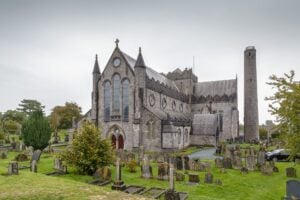
Rather than lying flat over a burial as intended, the stone had been cut down into a square block and pressed into the internal face of the east wall of the south transept, functioning as ordinary building material. Only in 2015, during excavations at the site, did it come to light again.
The slab dates to the 13th or 14th century and is made from fossiliferous limestone, a stone type common in the Kilkenny area, its surface embedded with the faint outlines of ancient marine creatures. Small in its surviving form, measuring roughly 18 centimetres by 12 centimetres, it retains an incised fleur-de-lis cross terminal, the decorative leaf-shaped finial that would once have crowned a ringed or Latin cross carved along its face. This kind of ornamental graveslab was a recognisable feature of medieval ecclesiastical commemoration in Ireland, typically marking the burial of someone of local standing. What is quietly remarkable here is not the carving itself but the decision, at some unknown point, to reshape and repurpose it entirely. The stone was trimmed, rotated, and mortared into a wall, its commemorative function erased in favour of structural convenience.