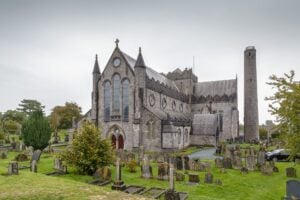
A fragment of a 13th or 14th-century slab, cut from fossiliferous limestone, the kind of stone in which the outlines of ancient marine creatures are still faintly legible, was taken from wherever it had originally lain and set into the western entrance pier of the main gateway into the churchyard at St Mary's parish church in Kilkenny. The stone is not large, measuring roughly 74 centimetres long and 45 centimetres wide, but it carries an incised cross-head with fleur-de-lis termini, the three-lobed decorative flourish more familiar from heraldry, used here to finish the arms of the cross in a manner typical of high medieval funerary stonework in Ireland.
What makes this fragment particularly legible as an object with a complicated afterlife is the physical evidence of its reuse. Two slots were cut into the stone to accommodate iron brackets, and those cuts truncate the cross-head itself, slicing into the very decoration that once gave the slab its meaning and identity. The person who made those slots was not treating the stone as a graveslab at all; it had become raw material, a convenient block of dressed limestone to be fitted into a gateway. The slab has since been removed from the pier and is now stored within the graveyard at St Mary's, which means it survives, though in a state that records at least three distinct phases: its original carving, its adaptation as structural infill, and its eventual retrieval.