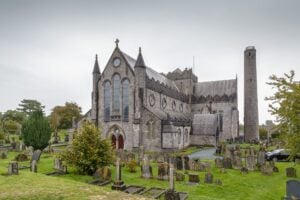
It was only during archaeological monitoring of the former Deanery Orchard, now partly a park and carpark roughly forty metres south-east of St Canice's Cathedral, that the slab was turned over and its true nature became apparent. The underside, which had been pressed into service as a threshold, bore an incised fleur-de-lis cross and orb, and along its left edge, an inscription in Norman-French using Lombardic lettering, the rounded, decorative script common to medieval monumental carving. The text reads +DAVI:FI:WM, most likely commemorating one David FitzWilliam. The slab itself is coffin-shaped, cut from carboniferous limestone, and dates to the thirteenth or fourteenth century. Whoever repurposed it as a step had trimmed away the base and part of one side to make it fit.
The ground where it was found has a long and layered past. In the early medieval period, this area formed part of the southern precinct of Cill Chainnigh, the ecclesiastical settlement from which Kilkenny takes its name. By the later medieval period it had become the plot associated with the manse house of the cathedral's precentor, a senior cleric responsible for music and liturgy in the chapter. Coach Road, which separates the site from the Deanery on its western side, was built in 1690, and at some point before John Rocque mapped Kilkenny in 1758, the land had become an orchard serving the Deanery. Rocque's map shows it as an open garden; the stone fences that divided it into three enclosures came later, added during the nineteenth century. It was within one of those divisions that the graveslab, already mutilated and inverted, had been set into the ground.
The slab has since been moved to the north transept of St Canice's Cathedral, where it can be seen properly oriented and in something closer to the context for which it was made.