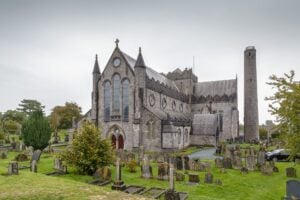
Cut from fossiliferous limestone, a rock embedded with the compressed remains of ancient marine creatures, the slab is coffin-shaped and measures just 0.87 metres long by 0.33 metres wide. Carved into its surface is a four-armed cross with fleur-de-lis terminals, the decorative lily-shaped flourishes common to medieval stonework, rising from a shaft interrupted partway down by a second, two-armed fleur-de-lis. The tooling is diagonal, the base truncated. Running in Latin Lombardic lettering along either side of the shaft is an inscription that begins promisingly and then breaks off: HIC IACET ALLIUS I on the right, PATERNOS on the left. "Here lies Allius I," it reads, followed by four dashes where the name or epitaph once continued, and then the request, "Pray for us."
The slab dates to the thirteenth or fourteenth century, a period when Kilkenny was a prosperous Anglo-Norman urban centre and carved limestone memorials of this type were relatively common among its merchant and ecclesiastical classes. What makes this one quietly arresting is the incomplete name. Whether through deliberate truncation, damage, or simple erosion, whoever Allius I was, and whatever followed those four missing characters, has not survived. The PATERNOS on the left side is understood as a fragment of the Latin prayer formula rather than a personal name, a standard medieval appeal to those passing by to offer intercession. The slab spent decades set into the floor of a room known as the Monuments Room, placed there in the 1960s, before being moved to its current position in the south transept in 2015.