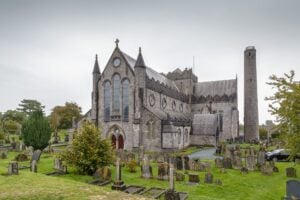
They were not lost there by accident. The working theory is that they were deliberately cleared from a graveyard, most likely attached to either St Mary's parish church or St John's Priory in Kilkenny, and packed into the rubble used to form a protective apron around the piers of a late medieval bridge, just north of the present John's Bridge. The stones served an entirely practical purpose, their inscribed surfaces facing nowhere in particular, until drainage excavations between 2001 and 2003 pulled them back into the light.
One fragment among the thirteen carries a detail that lifts it out of the category of anonymous stonework. The slab, limestone, heavily worn by water and measuring roughly 1.39 metres long, bears an incised Norman French inscription along one edge, cut in Lombardic lettering, a rounded, decorative script common in medieval monumental carving. The text reads AGAT:DE:LEYE, most likely the name Agatha de Leye. That name is not entirely without a paper trail. A deed held in the Kilkenny Corporation Archives, dating to before 1299, records both an Agatha de Leye and her sister Johanna, and the slab itself has been dated to the fourteenth century. The gap between the documentary Agatha and the woman commemorated in stone is narrow enough to be suggestive, though not narrow enough to be certain.
The slab is now held at the Medieval Mile Museum, which occupies the former St Mary's parish church, one of the very ecclesiastical sites from which the graveslabs may originally have been taken. There is a quiet circularity to that arrangement, even if it was arrived at by way of a riverbed.