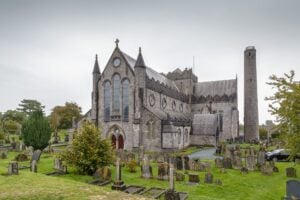
It is a small but quietly arresting sight: the slabs stand like silent attendants just east of the south doorway, their original horizontal purpose reversed, preserved above ground rather than sinking further into the earth beneath them.
Both slabs date from the 13th or 14th century, and the one recorded here is a tapering limestone slab, broader at the top and narrowing slightly toward the base. It measures roughly 82 centimetres above ground level, though its lower portion, including the base of its carved cross, disappears below the surface. Around the perimeter runs a broad chamfer, a bevelled edge cut at an angle, which gives the slab a certain deliberate finish. The east face carries an incised cross, meaning the design is cut into the stone rather than raised from it. The cross has four arms, a central boss, and terminals shaped as fleurs-de-lis, the stylised lily form that appears widely in medieval ecclesiastical decoration across Europe. The shaft of the cross is formed by two parallel incised lines, a restrained and precise piece of stonework that speaks to the craft conventions of its era. A graveslab of this kind would originally have lain flat over a burial, marking the grave of someone of enough local standing to warrant a carved stone rather than an unmarked plot.