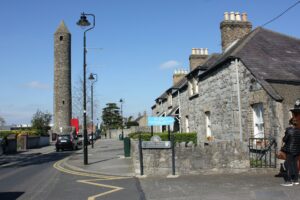
The visible boundary is not where the medieval graveyard ended, and excavations have confirmed that the dead were once laid out across land that now lies firmly outside the enclosure.
Chapelizod sits on the River Liffey and has long been considered one of the older settled villages in the Dublin area. When archaeologists investigated St. Martins Row in 1992, they uncovered burials that pre-dated a ditch on the same site. That ditch was dated, on the basis of potsherds, to somewhere in the 13th or 14th century; pottery fragments of datable types are a standard tool for establishing rough chronology when documentary evidence is absent. The burials lying beneath and beyond it were therefore older still, meaning the graveyard extended to the north-west of where the current boundary wall now stands. The findings were recorded by King in 1993 and later compiled by archaeologist Geraldine Stout. The church itself, dedicated to St. Lawrence, occupies the site where this medieval burial ground was centred, though the precise origins of religious activity on the plot are not firmly established from the available notes.
The church and its yard are straightforward to find in the village centre, just off the main road through Chapelizod. The boundary wall is itself worth a slow look, knowing that the graveyard it encloses was once larger and that medieval burials lie beyond its north-western edge, beneath what is now ordinary street-level ground. Visitors with an interest in the archaeology rather than just the standing fabric might find it useful to read King's 1993 report beforehand, as the physical evidence of the 1992 excavation is no longer visible above ground.