
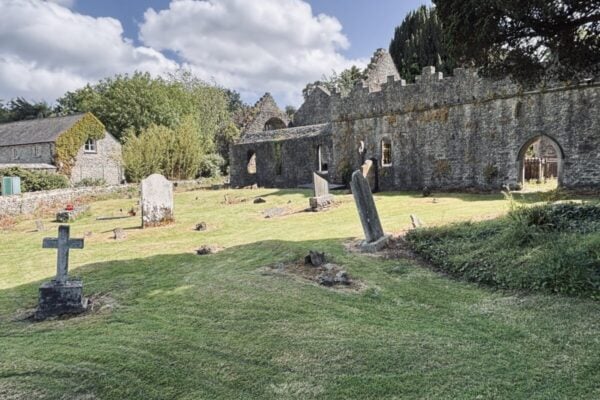
Graveyard, Dublin South City, Co. Dublin
Co. Dublin |
Burial Grounds
A graveyard that predates the church it neighbours is an unusual arrangement, and the old burial ground beside St James' Parish Church on the south side of Dublin carries exactly that quiet inversion.
The ground holds burials reaching back to the sixteenth century, meaning people were being interred here long before the enclosing stone wall was raised, and possibly before the present church took the form we see today.
The graveyard is a substantial rectangular plot, measuring roughly 96 metres north to south and 60 metres east to west, sitting to the north of St James' Parish Church. The surrounding wall dates to after 1700, giving the space a more formal, bounded character than it would originally have had. Máire Ní Mharcaigh, writing in 1997, noted that the old graveyard, with its sixteenth-century burials, surrounds the church on three sides, suggesting the burial ground once wrapped around the building in a way that the current layout only partially reflects. The site appears on John Rocque's 1756 map of Dublin City, one of the most detailed surveys of the city made in that era, which shows the church and its graveyard clearly to the north, fixing the site firmly in the Georgian-period streetscape even as the burials themselves reach back considerably further.
The graveyard sits within what is now a well-used part of the city, and the remnants of earlier use are easy to walk past without registering their age. The post-1700 stone wall is the most immediately visible historic feature from the street. Those with an interest in early modern Dublin burial practice or in the cartographic history of the city may find it worth pausing over Rocque's map beforehand, as it provides a sense of how the site fitted into the wider neighbourhood before the area was built up to its current density. The sixteenth-century burials are not individually marked or interpreted on site, so the significance of the ground's age requires a little prior knowledge to appreciate.
Ref: DU05217
04-Essential
Nearby Places
Visitor Notes
Added by

Pete F
Ní Mharcaigh, M. 1997 The medieval parish churches of south-west County Dublin. Proceedings of the Royal Irish Academy 97C, 245-96.
Rocque, J. 1756 An exact survey of the city and suburbs of Dublin. Available at https://libguides.ucd.ie/findingmaps/mapshistDublin Accessed on 5 January .