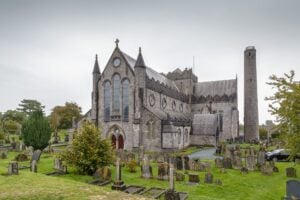
When engineers began laying pipes for the Kilkenny Main Drainage Scheme between 1996 and 1998, archaeologist Martin Reid found himself excavating a trench roughly 70 metres long and no more than three metres wide through ground that turned out to hold 261 individuals, all belonging to the graveyard of the Dominican friary known as the Black Abbey. The abbey itself still stands, a substantial 13th-century structure on what is now Abbey Street. But its graveyard had largely vanished from the surface of the city, absent even from John Rocque's map of 1758, and its full extent remains undefined.
The burials are thought to date from the 13th century to the mid-16th century, with some evidence for continued use into the late 17th century. Most of the dead were laid out in the conventional Christian orientation, head to the west, though a handful deviated slightly, and one juvenile was buried at an angle that suggests either individual circumstance or a different tradition. Of the 261 individuals recovered, 181 were adults and 80 were juveniles or adolescents, a proportion that speaks to the ordinary, grinding mortality of a pre-modern town. Osteological analysis by Buckley found that over half the population had died before the age of 36, and fewer than 11 per cent reached what would then have been considered old age, that is, 46 or older. The bones also suggested a population that ate reasonably well, with a diet low in sugar and refined carbohydrates, and showed relatively few signs of nutritional deficiency. What they did show was hard physical labour, reflected in vertebral degeneration, and a striking pattern of spinal anomalies that Buckley interpreted as possibly indicating a strong genetic connection among those buried there.
The graveyard extended considerably further than the drainage trench revealed. Further excavations on the south side of the church, including work at the rear of No. 13 Blackmill Street in 2000 by Niall Gregory, uncovered 19 more inhumations. Test-excavations in the sloping garden of Blessed Felix House, roughly 50 metres south of the church, found both a stone boundary wall and additional skeletal remains, suggesting that edge of the cemetery. Fragments of the abbey's precinct wall, a substantial structure enclosing the friary grounds, have been uncovered at several points nearby, though its full circuit has never been traced. The graveyard is not marked, not visible, and not commemorated on the surface. It is simply there, under the everyday city.