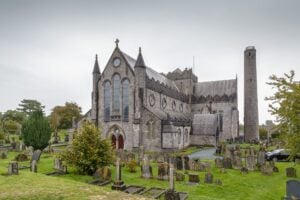
An anchorite, from the Greek for "one who withdraws", was walled or sealed into such a cell, often permanently, as an act of extreme devotion. The cells at St Canice's were not grand constructions; they were lean-to cubicles, formed by placing small roofs over older foundations on the north and south sides of the chancel sometime before around 1500, creating cramped spaces that would have been austere by any measure.
The history of these cells has been pieced together slowly, across several centuries of investigation. John Prim first noticed the underlying foundations in 1845, identifying them as the probable nave of an earlier, more ancient church on the site. He and his colleague James Graves published a plan of the cathedral in 1857 marking the outline of these foundations on both sides of the chancel. The cells themselves were mentioned in the seventeenth century by Bishop David Rothe, which places their use well within the medieval period. In 1866, the northern cell yielded a striking discovery when a scaffold pole was sunk into its floor: two flag-lined graves, lying nearly four feet below the level of the choir, thought to be the burials of hermits who had occupied the cell. The southern cell is less well documented, though Prim wrote in the Kilkenny Moderator in November 1865 that the removal of plaster from the walls had revealed clear evidence of a similar structure, including the marks of a lean-to roof against the south wall of the transept. The round-headed doorway that once gave access to that southern cell from the south chapel is still visible today, and a mortar floor uncovered during partial excavation in 2013 may represent the original surface on which those hermits lived.