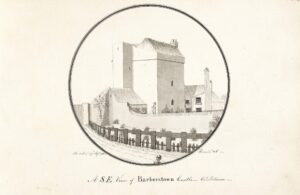
When construction crews began cutting an access road and clubhouse for the south golf course of the K Club in County Kildare, they did not expect to uncover evidence of a medieval industrial operation. The ground works, subject to archaeological monitoring, revealed the remains of a limekiln buried close to the surface. A lime kiln is a structure used to burn limestone at high temperatures, converting it to quicklime, which was then used in building mortars, agricultural lime, and whitewash. This one had been quietly sealed in the soil, roughly 140 metres south-east of a motte, the earthen mound at the core of a Norman-period fortification, suggesting it once served a working landscape shaped by medieval activity.
Excavation of the kiln revealed a central firing bowl, approximately three metres wide and 0.6 metres deep, with two flues running outward to the north-west and south-east. The bowl and the mouths of the flues were lined with clay-bonded limestone cobbles and small stones, most of them undressed and roughly the size of a large brick. The flues appear originally to have been roofed with capstones, though the upper portions of the structure had been disturbed and truncated before excavation could reach them. The north-west flue was noticeably broader than the other, suggesting it may have functioned as a rake-out pit, the channel through which spent ash and clinker would have been cleared between firings. Inside the firing bowl, successive layers of charcoal, burnt clay, and fractured limestone recorded the chemistry of the kiln's final use. No slaking pit, the basin where quicklime would have been doused with water to produce the usable slaked lime, survived, though disturbance in the surrounding area may account for its absence. The only datable objects recovered were two abraded fragments of medieval pottery found within the clay bonding of the kiln itself, one of them tentatively identified as Dublin ware of thirteenth or fourteenth century date, placing the structure within the Norman and later medieval period of settlement in the Kildare region.