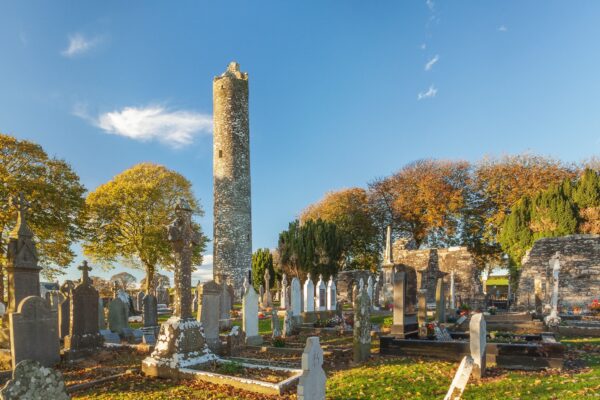
Possible Round Tower at Faughart, Co. Louth
Co. Louth |
Round Towers
At Ireland's most sacred birthplace, two mysterious mounds in St. Brigid's graveyard may hide the foundation of a vanished round tower—but archaeologists' shovels have yielded only tantalizing uncertainty where definitive answers should lie.
This potential round tower site at Faughart Upper represents one of the more speculative entries in Irish round tower studies, based on archaeological investigation of two mounds within the graveyard that produced inconclusive results. The suggestion that one mound may represent the base of a round tower comes from round tower expert G.L. Barrow, though the evidence remains uncertain.
Archaeological Investigation
L. Connor's partial excavation of the two mounds in the graveyard failed to provide definitive conclusions about their nature or origin. The inconclusive results highlight the challenges archaeologists face when investigating heavily disturbed sites like active graveyards, where centuries of burials, landscaping, and maintenance activities can obscure or destroy earlier archaeological features.
Expert Assessment
G.L. Barrow's suggestion that one mound might represent a round tower base carries significant weight, given his status as the leading authority on Irish round towers and author of the comprehensive gazetteer "The Round Towers of Ireland: A Study and Gazetteer" (1979). However, even Barrow's assessment appears cautious, presented as a possibility rather than a definitive identification.
Challenges of Round Tower Identification
Identifying round tower bases through archaeology can be extremely difficult, particularly when only foundation-level remains survive. Round tower foundations can be confused with other circular structures like mill bases, well houses, or even natural features. Without distinctive architectural elements like doorway stones, window fragments, or characteristic masonry, positive identification becomes problematic.
Significance of Location
Faughart Upper is a site of considerable historical importance, traditionally associated with St. Brigid's birthplace and containing significant early Christian remains. The presence of a round tower would fit the ecclesiastical context of the site and align with the pattern of round towers being built at major early Christian centers.
Limitations of Current Evidence
The speculative nature of this identification reflects the broader challenges facing round tower studies. Many towers have been so completely destroyed or buried that only suggestive archaeological features remain. Without more extensive excavation or discovery of diagnostic artifacts, the Faughart mounds remain in the category of "possible" rather than "confirmed" round tower sites.
Need for Further Investigation
The inconclusive nature of the initial excavation suggests that more comprehensive archaeological investigation might resolve the question. Modern archaeological techniques, including geophysical survey and more extensive excavation, could potentially provide the evidence needed to confirm or reject the round tower hypothesis.
Historical Context
If a round tower did exist at Faughart Upper, its association with St. Brigid would place it among the most historically significant round tower sites in Ireland. The saint's connections to early Irish Christianity and the site's continued importance as a pilgrimage destination would have made it an appropriate location for such a monument.
Current Status
The site remains in the category of unconfirmed round tower locations, where archaeological evidence is suggestive but not conclusive. This classification serves as a reminder that the distribution of Irish round towers may have been more extensive than surviving examples suggest, with many sites lost to time and human activity.
Good to Know
Location: Faughart Upper, County Louth (within graveyard)
Status: Speculative/unconfirmed
Archaeological evidence: Two mounds, one possibly round tower base (L. Connor excavation)
Expert assessment: G.L. Barrow suggestion (cautious)
Investigation results: Inconclusive
Historical context: Associated with St. Brigid's birthplace
Need: Further archaeological investigation for confirmation
Tags
- archaeological mounds, County Louth, Faughart Upper, G.L. Barrow assessment, inconclusive excavation, L. Connor investigation, possible round tower, speculative identification, St. Brigid birthplace, unconfirmed site
Visitor Notes
Added by