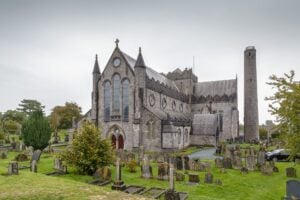
The Black Abbey, formally the Dominican Priory of the Holy Trinity, has never passed out of Dominican possession, which makes it something of an anomaly among Irish friaries, most of which were suppressed, ruined, or absorbed into other uses after the sixteenth century. What survives today is a layered structure, part medieval fabric, part nineteenth-century restoration, and underneath both, the buried footprint of a far larger complex than what is visible above ground.
The priory was founded in 1225 by William Marshal the younger, who died in 1231, making it one of the earlier Dominican establishments in Ireland. The Dominicans, also known as the Black Friars for their black cappa worn over a white habit, characteristically placed their houses just outside city walls, within a walled precinct of their own, and Kilkenny was no exception. At its medieval extent, the precinct stretched from Blackmill Street in the west to the River Breagagh to the north, and probably as far south as the Tilbury Tower. The church itself was a large T-plan structure with an aisled nave, and a 1540 description of the claustral buildings to its north lists a belfry, dormitory, chapter house, granary, king's chamber, prior's chamber, and various other structures including something recorded simply as a 'castle' over the gate. By 1758, when the cartographer John Rocque mapped Kilkenny, the chancel and cloister were already ruinous; the chancel was demolished outright in 1775. Excavations in 1976 by Raghnall Ó Floinn and again in 2000 by Frank Ryan recovered sections of its walls and sections of tiled floor, while a geophysical survey in the prior's garden, the ground between the Breagagh and the north side of the church, traced further portions of the cloister and north range beneath the surface.
The restored church contains several objects worth attention. A Decorated-style five-light window, reputedly the largest of its kind in Ireland, fills almost the entire south gable of the south transept. A 14th-century limestone figure of St Catherine of Alexandria, patron of the Dominican order, is held in the priory museum, and a 15th-century alabaster carving of the Trinity, uncovered during early 19th-century restoration work, is displayed in a glass case on the south wall of the transept. Stone coffins and monumental slabs, the oldest dating from the thirteenth century, are gathered in the yard outside the transept. Beside the River Breagagh, a reconstructed section of a medieval window from the west range of the cloister still stands.