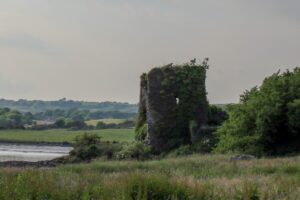
The enclosure measures approximately 38 metres north to south and 42 metres east to west, dimensions that place it comfortably within the range of a typical Irish ringfort, or rath. These were the farmsteads of early medieval Ireland, probably built and occupied between roughly 500 and 1000 AD, though many were constructed earlier or later. The earthen bank, raised by piling up soil dug from a surrounding ditch, would have defined the boundary of a family's domestic space, enclosing a house, outbuildings, and livestock. At Lissanoohig, that bank survives to a height of 2.15 metres, which is a reasonable state of preservation for a structure of its age and type.
The site sits on a gentle north-west-facing slope, which is fairly characteristic of ringfort placement across Ireland. Early farmers tended to favour sheltered, well-drained ground with good visibility over the surrounding landscape, and a gentle slope provides both. What is most striking about the current condition of the enclosure is the vegetation: the interior is heavily overgrown with ferns, which gives the impression of a space that has been slowly reclaimed since it was last actively used. Fern growth of this density often signals ground that has remained largely undisturbed for a long time, which is itself a kind of preservation.