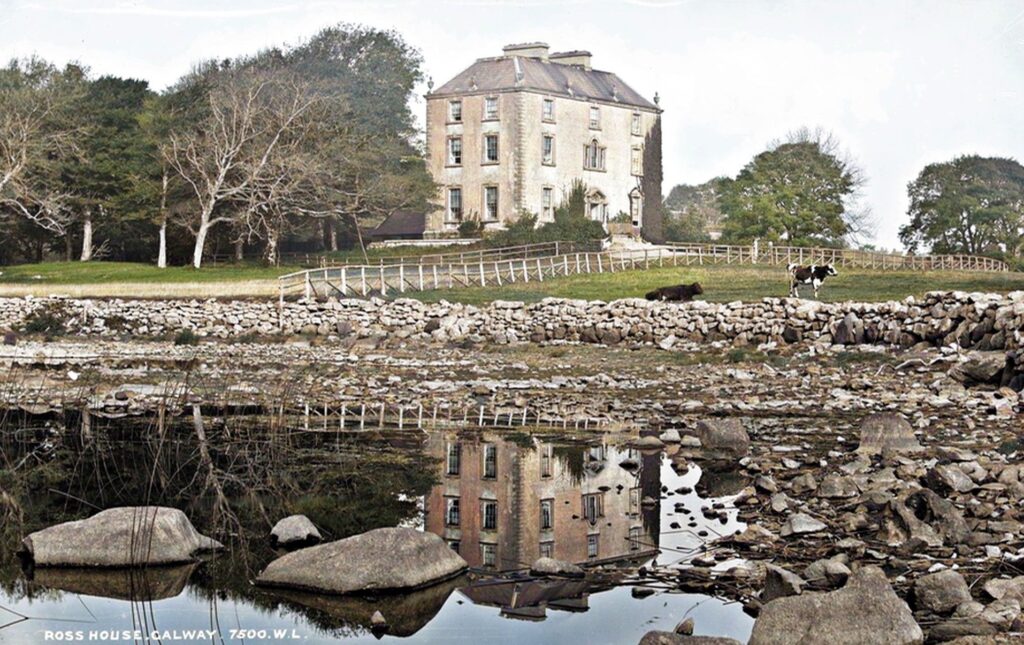
Ross Castle sits about 14km north-west of Galway city, down a side road off the N59 near Rosscahill, on the shore of Ross Lake with Croagh Keenan across the water. Despite the name, it hasn't been a castle for a long time. What stands there now is a Georgian manor house wrapped around the remains of an older fortified one, on a 120-acre estate with a courtyard of outbuildings, a walled garden and six enormous yew trees.
Nobody quite agrees on when it was built
Almost every account gives a different founding date. The estate's own literature says 1539 and credits the O'Flahertys, the Gaelic lords of Iar Connacht, known to Galway's merchant families as the "Ferocious O'Flahertys". Architectural descriptions refer to a 15th-century O'Flaherty tower house. A third and equally confident version says 1590 and credits Robert Martin.
These probably aren't in conflict. The likeliest sequence is that an O'Flaherty tower house stood here first, and Martin built onto and around it. He was one of the Tribes of Galway, the fourteen merchant families who ran the city, and is said to have been the first of them to build a home outside the city walls. The place became known as the ancient home of the Martins of Ross. A carved coat of arms in the dining room marks his marriage to Kate Lynch, from another of the Tribes.
The outer walls still date from that build. The courtyard buildings went up in two phases, around 1590 and 1670, with a further wing added in the 1770s for stables, coach houses and staff quarters.
Then it burned
A fire in 1770 gutted the interior and took the roof. What replaced it was Georgian: a tall, square, heavily built block with the kitchens half-buried below ground level and a deep dry area running right around the base. The whole thing was built with defence in mind, though the 1798 Rebellion never came close enough to test it.
Violet Martin, who grew up in the house, was unsentimental about the architecture in her 1917 memoir Irish Memories. She thought it did her great-grandfather no credit "plain, blocky and unlovely" though she conceded it had two fine rooms and a good staircase, its mahogany balusters salvaged from a shipwreck. She also noted the affection five generations of the family had for it in spite of the draughts, the stairs, and chimneys that defeated every sweep who tried them.
The solidity did get tested. On the night of 6 January 1839, during the Night of the Big Wind, still the most destructive storm in recorded Irish history, her grandfather moved the entire household into the vaulted kitchen and told them that "if Ross fell, not a house in Ireland would stand that night". Plenty of houses did fall. Ross stayed up, though sea spray carried in from an Atlantic six miles away left the lawn white by morning.
Napoleon's orderly, and an Irish R.M.
Violet Martin (1862–1915) is the best known of the family. Writing as Martin Ross, a pen name taken from the house, she and her cousin Edith Somerville produced Some Experiences of an Irish R.M. in 1899, comic stories about an English resident magistrate posted to rural Ireland, and a considerable commercial success. Ross is said to have been the model for the magistrate's house. Channel 4 and RTÉ adapted the stories as The Irish R.M. in the 1980s.
An earlier resident was Major Thomas Poppleton, who married into the Martins. He had been the British orderly officer assigned to Napoleon during his exile on St Helena, which made him the man responsible for keeping daily track of him. More recently the house was home to Claude Chavasse, an Englishman who became a Celtic scholar, a committed Irish speaker and a well-known character around Galway.
The Martin coat of arms is worth a look while you're in the dining room. It's carved on a dark limestone slab that came from an old house in Galway city, dated 1649, showing a Calvary cross between a sun and a crescent moon, with a six-pointed star as the crest and the motto Sic itur ad astra. Family tradition, recorded in the pedigrees at Dublin Castle, holds that the arms were granted by Richard the Lionheart to one Oliver Martin in the Holy Land, and that Oliver shared the king's captivity in Austria afterwards. Take that for what it is.
Fifteen years and a lot of second-hand slate
By the 1980s the house was a shell. The roof had gone, the floors had fallen in, and only the walls were standing.
In 1985 Elizabeth and George McLoughlin were driving the Moycullen–Oughterard road, looking for an Irish holiday home, when Elizabeth spotted the ruin in the distance. The gates were locked, so George climbed the fence and hauled her over after him. He looked at the wreck; she looked at the view and told him this was the one.
He was a New York property developer with firm opinions about location. She was a concert pianist trained at the Vienna Academy of Music who had already restored a landmark house in Millburn, New Jersey. The holiday project turned into a full-time one, and the rebuild took fifteen years: the main house, the courtyard cottages, a greenhouse, a summer cottage, a boat house, a chapel and an outdoor privy.
The roofing is the part people remember. George wanted blue Bangor slate (dense, dark Welsh slate, the standard on good Irish roofs before modern tiles took over) and rather than buy new, he drove around the countryside looking for farm buildings that had recently been re-tiled. He worked on the assumption that no farmer would throw out slate that good, and that it would be stacked neatly somewhere in the yard. He was right often enough to end up with slate to spare, at the cost of a trailer chassis that broke under the weight and a car that got stuck in the mud more than once.
What was under the plaster
The best discovery came later. When the 18th-century plaster was stripped from the ground floor, it came away from a brick vaulted ceiling laid in what bricklayers call soldier style, with the bricks set upright on end rather than flat. Blocked fireplaces, bake ovens and doorways came out of the walls at the same time. As far as anyone has been able to establish, the vault is unique in the west of Ireland.
The six yews
Standing in open ground in the gardens are six yews of real age, probably several hundred years old. They don't read as tree-shaped in the usual sense. Each trunk is nearly as wide as its canopy, the branches go straight up, and the dark evergreen foliage closes over a hollow, shadowed interior.
Yew turns up constantly in Irish graveyards and church grounds, partly for its long association with sanctuary and protection, and partly because the trees simply outlast everything around them; a yew can pass a thousand years and still fruit and put out new growth each spring. Branches are still cut in Ireland to stand in for palm on Palm Sunday.
The tree carries a love story too. Baile of the Sweet Speech and Aillinn were in love from childhood but were kept apart, and both died of grief, he near what is now Dundalk and she in Leinster. A yew grew over Baile's grave; in most versions an apple tree grew over Aillinn's. Generations later both trees were felled and cut into writing tablets for the court at Tara. When the two tablets were brought together, they sprang shut around one another and could not be separated, so they were kept that way in the library at Tara.
The gardens around the yews are worth the walk on their own. From the front door the parkland runs off between the lake and the woods, but the gardens behind are small in scale by comparison. You leave the courtyard with its Japanese anemones and roses through a restored carriage entrance and a Gothic arch, into a series of enclosures divided by giant box hedge and mature shrubs so that each reads as a separate room. There's a fountain, a greenhouse with a productive apricot tree, stone sculpture and statuary, and a red-brick pond with large carp in it. A tall gate leads into one of the largest walled gardens in Galway, the high walls intact, now given over mostly to vegetables.
George McLoughlin died in June 2024. What he and Elizabeth left behind is a working house rather than a museum, a private home that doubles as a self-catering let and a wedding venue, which is roughly what they set out to build.