A chest tomb is a box-shaped funerary monument, typically raised above ground level, and the carved panels forming its sides were often among the most accomplished stone-cutting of their era. That this one ended up as rubble fill tells its own quiet story about how the past gets swallowed by later building work.
The panel, recovered during excavation work recorded under licence 12E0314, dates to the 16th century and is made from fossiliferous limestone, a stone in which the compressed remains of ancient marine creatures are visibly embedded in the matrix. It measures 0.8 metres long, 0.45 metres wide, and 0.08 metres thick, and its carved surface depicts the Arma Christi, or instruments of the Passion, rendered in false relief within a frame moulding. Reading from right to left, the symbols include the scourging pillar and ropes, the lance, the seamless gown, the dice, the cup, and the crown of thorns encircling the sacred heart. The panel is broken at the mid-point of that final motif. The carving has been tentatively linked to the Kerin school of monumental sculpture, a workshop tradition associated with high-quality ecclesiastical stonework in the region during this period. The wear patterns across the carved face confirm that the panel spent time as a floor surface before it was repurposed beneath the altar, suggesting a sequence of displacement and reuse that may never be fully reconstructed.
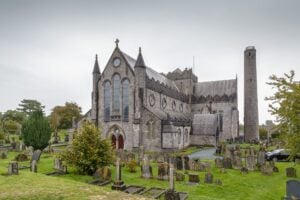
The find came to light through excavation of the chancel at St Mary's, a church with deep medieval roots in the city. The panel itself is not on open display in the conventional sense; its existence is known primarily through the unpublished excavation report prepared by Cóilín Ó Drisceoil. What it offers, even in its fragmentary state, is a close look at the sophistication of 16th-century devotional sculpture in Kilkenny, and a reminder of how thoroughly later generations could repurpose the monuments of earlier ones without a second thought.