He wears an amice and chasuble, the layered vestments of a medieval cleric, and his head rests on a chevron-decorated pillow, the whole figure enclosed within a cusped ogee frame. The carving is described as well and competently executed, and the surface remains remarkably well preserved, which makes its history all the more striking: it did not survive the centuries in a church or crypt, but at the bottom of a river.
The slab was one of five partial funerary monuments recovered from the Nore during archaeological excavations carried out as part of the River Nore Drainage Scheme. All five were found in association with the late medieval bridge immediately north of the present John's Bridge in Kilkenny city, close to St Mary's parish church and St John's Priory. Two explanations have been put forward for how they ended up there. Researcher Brady has suggested they were deliberately defaced and thrown into the river by iconoclasts during the Reformation in the 1540s, a period when religious imagery was systematically destroyed across Ireland and Britain. Doyle and O'Meara have offered an alternative reading, proposing that the slabs were seen simply as a convenient supply of stone and were used as rubble to reinforce the protective apron around the bridge piers. The two explanations are not entirely incompatible. The slab itself is fragmentary; the monk's legs and feet are missing, and a fracture in the stone may have been caused by pile-driving at the bridge site during the 1760s. A separate fragment found nearby, showing a partial shoe and folds of a garment, may belong to the same monument.
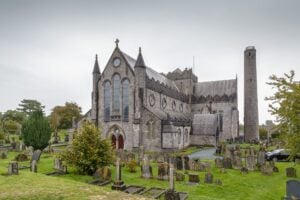
The slab is now on display at the Medieval Mile Museum in Kilkenny, housed in the former St Mary's parish church, the same building that once stood roughly a hundred metres from where the monument was found in the river.