
Promontory fort - coastal, Doire Leathan, Co. Donegal
Co. Donegal |
Forts
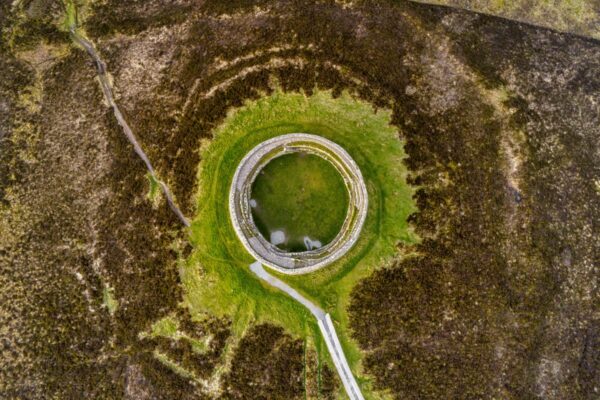
On the eastern edge of Teelin Bay in County Donegal, a promontory fort occupies a strategic position overlooking the Atlantic waters.
This ancient defensive site, measuring roughly 55 metres east to west and 57 metres north to south, forms an almost circular enclosure that was once separated from the mainland by formidable earthworks. Though time and weather have taken their toll, particularly on the northwestern side, visitors can still trace the remains of an earthen bank that once stood over two metres high, accompanied by a defensive ditch, or fosse, reaching depths of nearly two metres in places.
The fort's interior reveals intriguing features that hint at its long history of human use. A rocky knoll rises on the western side, whilst a later field wall divides the space, suggesting the site continued to serve practical purposes long after its military significance faded. Where the bank and fosse have suffered most damage on the northwest, a gap of about 2.7 metres may mark the original entrance, though centuries of deterioration make this difficult to confirm with certainty. The surrounding landscape of good pasture land speaks to why this location was chosen; not only did it offer natural defensive advantages, but the fertile ground would have sustained the community that once called this place home.
Archaeological investigations have helped piece together the fort's story, including test excavations conducted in 2004 at nearby Derrylahan, Kilcar, which examined land close to the promontory fort during development work. Whilst those particular trenches revealed no archaeological remains, the fort itself stands as documented in the Archaeological Survey of County Donegal, compiled in 1983, which catalogued field antiquities from the Mesolithic period through to the 17th century. Today, this coastal stronghold remains a tangible link to Ireland's Iron Age past, when such promontory forts dotted the coastline, serving as both defensive structures and symbols of power for the communities that built them.
Ref: DG02283
04-Essential
Nearby Places
Visitor Notes
Added by
