
Bridge, Dublin South City, Co. Dublin
Co. Dublin |
Bridges & Crossings
There is a particular kind of invisibility that belongs to ordinary infrastructure.
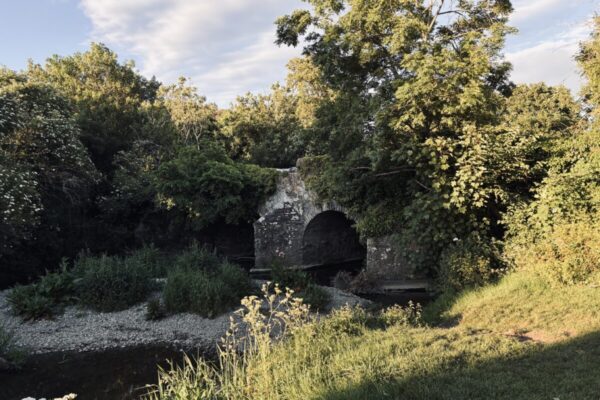
A road bridge in Dublin's south city carries pedestrians and traffic across the River Camac without any marker, plaque, or pause to suggest that something older once stood in precisely the same spot. The Camac itself is easy to overlook, a modest tributary that threads through the western neighbourhoods of the city before meeting the Liffey, and the crossing above it asks for no particular attention. That ordinariness, though, is part of what makes the site quietly interesting.
The Down Survey, carried out between 1655 and 1656 under the direction of William Petty, was among the most ambitious cartographic projects of seventeenth-century Ireland, commissioned to map forfeited Catholic-owned lands following the Cromwellian conquest. The maps it produced are remarkable documents, detailed enough to record individual townlands, roads, and water crossings. On one of those maps, a bridge appears at this location spanning the Camac, which means that well before the modern city had spread across this part of south Dublin, there was already a fixed crossing here serving whatever traffic moved along that route. The present structure occupies the same site, though no visible surface trace of the earlier bridge survives. The line of continuity is real, even if the physical evidence is not.
The River Camac is not always easy to follow through the city; parts of it run underground or between walls and fencing, and it tends to surface properly only at specific crossing points. This bridge is one such place where the river becomes briefly visible, running beneath a functional modern span. There is no heritage signage to explain the crossing's history, so arriving with the knowledge that a bridge was already documented here in the mid-seventeenth century changes what an otherwise unremarkable piece of urban infrastructure actually represents. The interest lies less in anything to see than in the layering of use, the fact that people have been crossing the Camac at this point for at least four centuries, and probably longer.
Ref: DU01224
04-Essential
Nearby Places
Visitor Notes
Added by
