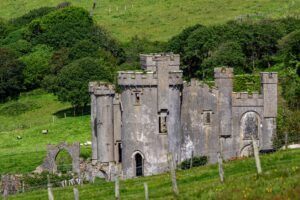
That alone gives it a quiet interest: the country house as a type was once ubiquitous across the Irish landscape, a physical expression of the landlord class that shaped rural life for centuries, and yet individual examples have disappeared in remarkable numbers, lost to fire, abandonment, and deliberate demolition during and after the upheavals of the early twentieth century.
The country house tradition in Ireland grew substantially from the late seventeenth century onward, as Protestant Ascendancy families built homes that ranged from modest gentry farmhouses to ambitious Georgian and Palladian piles. Ballinaboy itself sits in the Connemara region of Galway, an area more commonly associated with small tenant farms and the subsistence pressures that made the Famine years so catastrophic here than with the architectural ambitions of the landowning class. A house in such a setting would have occupied a particular kind of isolation, its demesne perhaps marked by a walled garden or a planted avenue, the usual apparatus of modest gentry life in the west of Ireland.
Without further detail surviving about this particular house, what remains is the outline of a type: a building that once organised the landscape around it, that figured in local memory as estate office, landmark, or simply the big house up the road, and that has since receded into the kind of quiet obscurity that makes the Galway countryside worth looking at slowly.