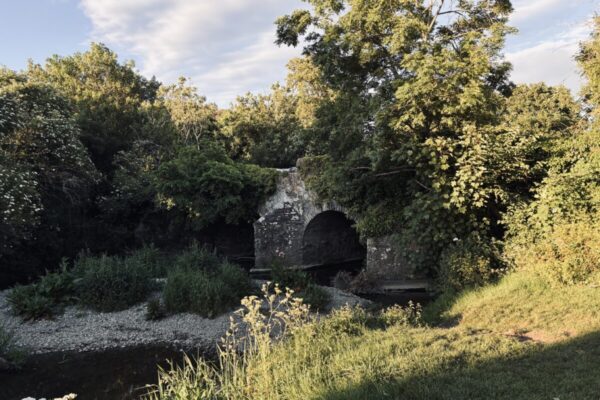
Bridge, Dublin City, Co. Dublin
Co. Dublin |
Bridges & Crossings
The bridge that carries traffic across the Liffey at Capel Street today is not the first to have stood here, nor the second, but at least the third, and beneath its current Victorian stonework lies a layered history that reaches back to the seventeenth century.
What makes the site particularly notable to engineers and architectural historians is a technical detail that most people cross without a second thought: an earlier incarnation of this crossing introduced a form of arch construction that had never been used in Ireland before.
The earliest recorded bridge on this site dates to 1676. That structure featured seven arches and a drawbridge, a practical necessity for river traffic at the time. According to O'Keefe and Simington's survey of Irish bridges, its arches employed three-centred intrado curves, a design in which the inner face of the arch follows a flattened, three-part curve rather than a simple semicircle. The effect is a lower, more elliptical opening, which can allow for greater spans without raising the road level. These are considered the earliest examples of that arch type in Ireland, which gives the site a quiet engineering significance that its current appearance does little to advertise. The bridge was replaced by Essex Bridge, built between 1733 and 1735, and that in turn gave way to the present Grattan Bridge, constructed between 1873 and 1875.
Grattan Bridge sits at the foot of Capel Street, connecting it to Parliament Street on the south bank, and it remains a busy pedestrian and vehicle crossing. There is no physical trace of the 1676 structure above the waterline, but the current bridge is worth pausing on for a moment, particularly from its parapets where the full curve of the Liffey quays is visible in both directions. Those interested in the earlier engineering history would do well to consult O'Keefe and Simington's work before visiting, as the significance is entirely invisible from the footpath. The name Grattan commemorates Henry Grattan, the eighteenth-century parliamentarian, though the bridge bearing his name postdates him considerably.
Visitor Notes
Added by