
Bridge, Dublin South City, Co. Dublin
Co. Dublin |
Bridges & Crossings
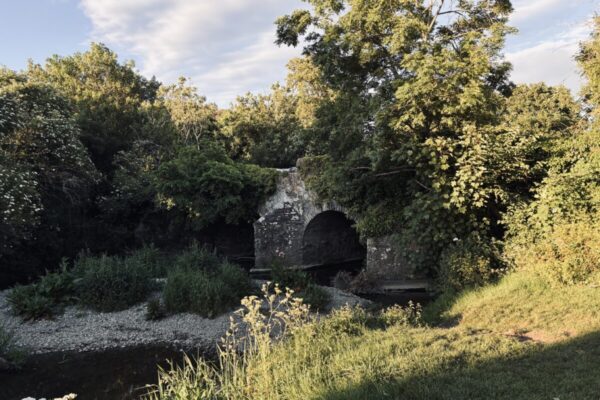
A crossing point on the Cammock River in Dublin's south city carries a history far older than its current concrete and tarmac suggest.
The Cammock, also known as the Camac, is a modest tributary of the Liffey, and for centuries the bridge that spanned it here marked something more significant than a convenient route across water. It sat on the boundary of Dublin City itself, a threshold that was already established by the early thirteenth century, placing this modest spot within the administrative and legal geography of medieval urban life.
The earliest cartographic record of the crossing appears on the Down Survey of 1655 to 1656, the ambitious mapping project commissioned under Oliver Cromwell and largely carried out by William Petty, which aimed to document Irish land ownership in extraordinary detail. That map names it 'Bowe bridge', a designation that hints at an older, vernacular identity now otherwise lost. The bridge appears again on Taylor's Survey of Kilmainham in 1671, confirming its continued use and local significance well into the seventeenth century. The scholarly work of Kenny, writing in 1995, draws on both sources to trace its role within the evolving boundary history of the city, noting references across pages dealing with the wider Kilmainham district and its relationship to Dublin's expanding limits after 1200 AD.
The present structure is of modern construction, so there is nothing medieval to observe in the fabric of the bridge itself. What remains is essentially positional, a point in the landscape where the convergence of river, road, and old city boundary still has a quiet coherence if you know what you are looking for. The Cammock runs through an area that rewards slow exploration on foot, and consulting historical map overlays, several of which are freely available through the Dublin City Libraries digital collections, can help a visitor locate the approximate line of the old city bounds and appreciate how a functional river crossing once served as a marker of civic jurisdiction.
Ref: DU01222
04-Essential
Nearby Places
Visitor Notes
Added by
