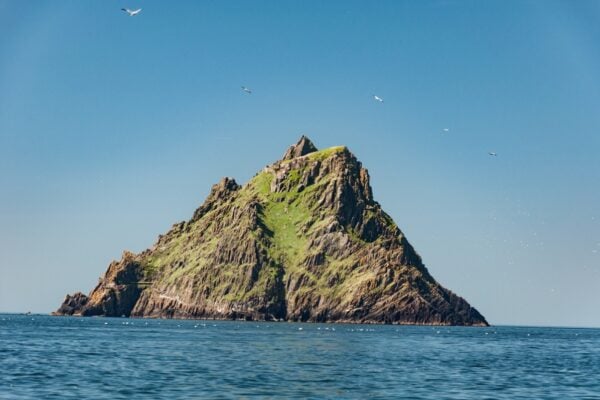
Church (in ruins), Illauntannig, Co. Kerry
Co. Kerry |
Churches & Chapels
On a small island in the Atlantic, just off the tip of the Kerry peninsula that divides Brandon Bay from Tralee Bay, an entire Early Christian monastic settlement survives within a cashel wall, the drystone enclosure that would have marked the sacred boundary of a community living at the very edge of the known world.
Illauntannig, the largest of the Magharee Islands, holds two oratories, three beehive huts, a souterrain (an underground stone-lined passage, likely used for storage or refuge), three leachts (low rectangular stone platforms associated with prayer and commemoration), a burial ground, a stone cross, cross-slabs, and a bullaun stone, a boulder with one or more artificial cup-shaped hollows traditionally used for grinding or ritual purposes. A second bullaun stone sits roughly a hundred metres to the south, at the edge of the sea. Fragments of five quern-stones, a hand-bell, and cross-slabs have all been recovered from within the enclosure, suggesting a community that was not simply passing through but working, worshipping, and persisting here across generations.
The larger of the two oratories, known as Oratory A, sits in the south-eastern sector of the enclosure and is one of the more remarkable structures. It is what scholars call a boat-shaped oratory, a form particular to early Irish Christianity, with slightly curved walls that taper toward each gable, echoing the hull of an upturned vessel. Built entirely in drystone corbelling, without mortar, its walls survive to a height of 2.6 metres internally, measuring 4.3 metres by 2.9 metres, though the roof is now gone. A rectangular lintelled window lights the east gable, and the doorway opens from the west wall. Inside, a drystone altar abuts the east wall directly beneath that window. Peter Harbison, writing in 1970, observed diagonal tooling on some of the stonework that he compared to techniques found on Irish Romanesque and early Gothic buildings, placing the construction of the oratory firmly in the twelfth century. An earlier visitor, the Earl of Dunraven, had noted a curved passageway at the west entrance; what remains today may be the exposed edge of a buried plinth rather than a passageway proper. Related remains on the nearby headland of Reennafardarrig, including a hut-site, old field walls, and a reportedly cross-inscribed boulder, suggest the settlement's influence extended beyond the island itself.
Visitor Notes
Added by